Advertisements
Advertisements
Question
| Column I | Column II | Column III | |
| 1 | Dispersion | Long-sightedness | Twinkling of stars |
| 2 | Refraction | Splitting of white light into component colours | Convex lens |
| 3 | Hypermetropia | Change in the direction of the ray of light due to change in medium | Spectrum of seven colours |
Advertisements
Solution
| Column I | Column II | Column III | |
| 1 | Dispersion | Splitting of white light into component colours | Spectrum of seven colours |
| 2 | Refraction | Change in the direction of the ray of light due to change in medium | Twinkling of stars |
| 3 | Hypermetropia | Long-sightedness | Convex lens |
APPEARS IN
RELATED QUESTIONS
Which property of light makes a pencil cast a shadow when it is held in front of a light source?
A wall reflects light and a mirror also reflects light. What difference is three in the way they reflect light?
Define the following terms used in the study of reflection of light by drawing a labelled ray-diagram:
- Incident ray
- Point of incidence
- Normal
- Reflected ray
- Angle of incidence
- Angle of reflection
The angle of reflection is equal to the angle of incidence:
(a) always
(b) sometimes
(c) under special conditions
(d) never
If a ray of light goes from a rarer medium to a denser medium, will it bend towards the normal or away from it?
In which material do you think light rays travel faster-glass or air?
State whether the following statement is true or false:
Refraction occurs because light slows down in denser materials.
What is meant by the ‘angle of incidence’ for a ray of light?
Light travels more quickly through water than through glass.
- Which is optically denser: water or glass?
- If a ray of light passes from glass into water, which way will it bend: towards the normal or away from the normal?
When a light ray passes from air into glass, what happens to its speed? Draw a diagram to show which way the ray of light bends.
A coin in a glass tumbler appears to rise as the glass tumbler is slowly filled with water. Name the phenomenon responsible for this effect.
Name the phenomenon due to which a pencil partly immersed in water and held obliquely appears to be bent at the water surface.
How does the light have to enter the glass:
to produce a large amount of bending?
The speed of light is more in glass than in water.
Light travels at a lower speed in water than in air.
Water is optically .......... than air.
Air is optically .......... than glass.
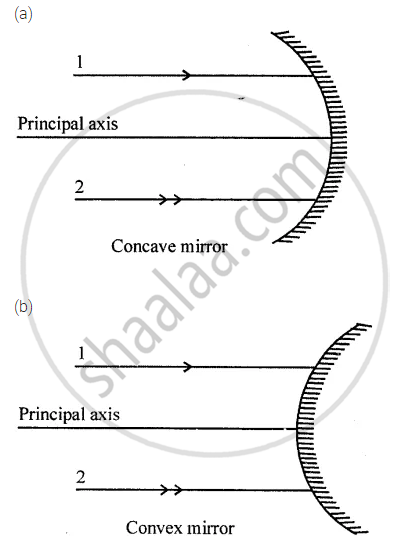
Draw suitable diagrams to illustrate how a beam of light incident parallel to the principal axis is reflected by:
(a) a concave mirror, and (b) a convex mirror
The diagram (figure) given below shows two parallel rays 1 and 2 incident on (a) a concave mirror, (b) a convex mirror. Draw the reflected rays and mark the focus by the symbol F.
What is the cause of refraction of light when it passes from one medium to another?
Define the principal focus of a concave mirror.
Light enters from air to glass having refractive index 1.50. What is the speed of light in the glass? The speed of light in vacuum is 3 × 10⁸ m s−1.
List four characteristics of the image formed by a concave lens of focal length 20 cm when the object is placed at a distance of 40 cm from its optical centre.
The phenomenon of change in the direction of light when it passes from one transparent medium to another is called ___________.
Due to _______ pencil looks bent in water, in the given experiment.
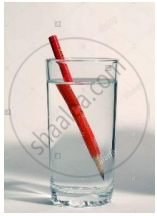
Observe the given figure and name the following.
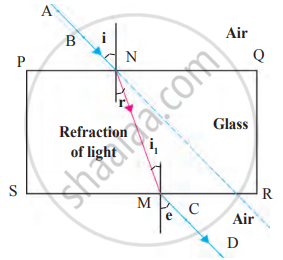
| Ray AB | |
| Ray NM | |
| Ray MD | |
| ∠ r |
State whether true or false. If false, correct the statement.
The angle of deviation depends on the refractive index of the glass.
Why does a ray of light bend when it travels from one medium to another?
The angle of incidence for a ray of light having zero reflection angle is ______.

The angle of incidence from air to glass at the point O on the hemispherical glass slab is.
How does the light travel?
The ratio of the sine of the angle of incidence to the sine of ______ is constant.
A water tank appears shallower when it is viewed from the top due to refraction.
The bottom of swimming pool appears to be less deep than the actual one because of
A normal is an imaginary line drawn ________ to the boundary at the point of incidence.
According to the second law of refraction, for a given pair of media, the ratio of the sine of the angle of incidence to the sine of the angle of refraction:
In the formula for absolute refractive index \[n = \frac{c}{v}\], the quantity c represents:
