Advertisements
Advertisements
Question
When a ray of light travelling in glass enters into water obliquely ______.
Options
it is refracted towards the normal
it is not refracted at all
it goes along the normal
it is refracted away from the normal
Advertisements
Solution
When a ray of light travelling in glass enters into water obliquely it is refracted away from the normal.
Explanation:
If a ray of light goes from a denser medium (glass) to a rarer medium (water), it bends away from the normal.
RELATED QUESTIONS
Fill in the following blank with a suitable word:
When light is reflected, the angles of incidence and reflection are ............ .
What is lateral inversion? Explain by giving a suitable example.
What type of reflection of light takes place from a cinema screen?
A boy with a mouth 5 cm wide stands 2 m away from a plane mirror. Where is his image and how wide is the image of his mouth?
The boy walks towards the mirror at a speed of 1 m/s. At what speed does his image approach him?
An extended object in the form of an arrow pointing upward has been placed in front of a plane mirror. Draw a labelled ray-diagram to show the formation of its image.
Define the following terms used in the study of reflection of light by drawing a labelled ray-diagram:
- Incident ray
- Point of incidence
- Normal
- Reflected ray
- Angle of incidence
- Angle of reflection
Write all the capital letters of the alphabet which look the same in a plane mirror.
The image formed by a plane mirror is :
(a) virtual, behind the mirror and enlarged.
(b) virtual, behind the mirror and of the same size as the object.
(c) real, at the surface of the mirror and enlarged.
(d) real, behind the mirror and of the same size as the object.
State two effects caused by the refraction of light.
State whether the following statement is true or false:
Refraction occurs because light slows down in denser materials.
A coin in a glass tumbler appears to rise as the glass tumbler is slowly filled with water. Name the phenomenon responsible for this effect.
A ray of light when passes from glass to air, bends towards the normal.
Draw suitable diagrams to illustrate how a beam of light incident parallel to the principal axis is reflected by:
(a) a concave mirror, and (b) a convex mirror
A ray of light A incident from air suffers partial reflection and refraction at the boundary of water.
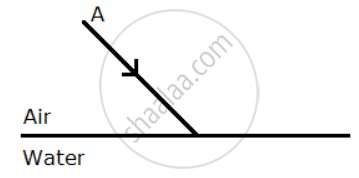
- Complete the diagram showing (i) the reflected ray B and (ii) the refracted ray C.
- How are the angles of incidence i and refraction r related?
Define the principal focus of a concave mirror.
List four characteristics of the image formed by a concave lens of focal length 20 cm when the object is placed at a distance of 40 cm from its optical centre.
A real image is formed by the light rays after reflection or refraction when they:
- actually meet or intersect with each other.
- actually converge at a point.
- appear to meet when they are produced in the backward direction.
- appear to diverge from a point.
Which of the above statements are correct?
Write scientific reason.
A pencil appears to be broken near the surface of water.
Numerical problems.
The speed of light in water is 2.25 × 10⁸ ms–1. If the speed of light in vacuum is 3 × 10⁸ ms–1, calculate the refractive index of water.
The refractive index of four substances A, B, C, and D are 1.31, 1.43, 1.33, 2.4 respectively. The speed of light is maximum in
A pencil when dipped in water in a glass tumbler appears to be bent at the interface of air and water. Will the pencil appear to be bent to the same extent, if instead of water we use liquids like, kerosene or turpentine. Support your answer with reason.
The phenomenon of light passing through the object is called ______.
When light passes from one medium to another the ray gets bent. This property of light is called ______.
Twinkling of stars and Mirage are the two phenomena occurring due to refraction.
When a light ray passes from a denser medium to a rarer medium, it bends:
According to the second law of refraction, for a given pair of media, the ratio of the sine of the angle of incidence to the sine of the angle of refraction:
