Advertisements
Advertisements
Question
A pencil when dipped in water in a glass tumbler appears to be bent at the interface of air and water. Will the pencil appear to be bent to the same extent, if instead of water we use liquids like, kerosene or turpentine. Support your answer with reason.
Advertisements
Solution
The pencil when dipped in water in a glass tumbler appears to be bent at the interface of air and water due to the refraction of light. The refractive index of different mediums is different. The refractive index of kerosene and turpentine is more than the water, due to this the pencil will appear to bend more in case of kerosene or turpentine than that in case of water.
Therefore the pencil will not appear to be bent to the same extent, if instead of water we use liquids like, kerosene or turpentine.
APPEARS IN
RELATED QUESTIONS
Name the phenomenon responsible for the following effect:
When we sit in front of a plane mirror and write with our right hand, it appears in the mirror that we are writing with the left hand.
Fill in the following blank with a suitable word:
When light is reflected, the angles of incidence and reflection are ............ .
Write the word AMBULANCE as it would appear when reflected in a plane mirror. Why is it sometimes written in this way (as its mirror image) on the front of an ambulance?
A wall reflects light and a mirror also reflects light. What difference is three in the way they reflect light?
The image of an object formed by a plane mirror is:
(a) virtual
(b) real
(c) diminished
(d) upside-down
If a ray of light goes from a rarer medium to a denser medium, will it bend towards the normal or away from it?
If a ray of light goes form a denser medium to a rarer medium, will it bend towards the normal or away from the normal?
Name the phenomenon due to which a swimming pool appears less deep than it really is.
In which material do you think light rays travel faster-glass or air?
What is meant by the ‘angle of incidence’ for a ray of light?
Light travels more quickly through water than through glass.
If a ray of light passes from glass into water, which way will it bend : towards the normal or away from the normal?
When a ray of light travels from water to air, it bends ............. the normal.
When a ray of light travels from air to glass, it bends .......... the normal.
The phenomenon of change in the direction of light when it passes from one transparent medium to another is called ___________.
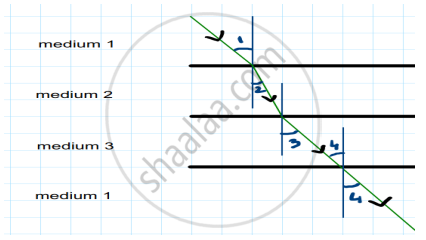
In the above diagram light is travelling through different media. It is noted by a scientist that ∠1= ∠3 = ∠4 but ∠2 < ∠1. Which of the following statement would be correct?
Which object use the reflection of light?
Which is optically denser out of the two medium M1& M2 having the refractive indices = 1.71 and 1.36 respectively?
When a light ray passes from a denser medium to a rarer medium, it bends:
According to the first law of refraction, the incident ray, the refracted ray, and the normal at the point of incidence:
The constant \[\frac{\sin i}{\sin r}\] for a given pair of media is called the:
