Advertisements
Advertisements
Question
Why does a light ray incident on a rectangular glass slab immersed in any medium emerges parallel to itself? Explain using a diagram.
Advertisements
Solution
Consider the diagram shown below in which EO is incident ray, OO' is refracted ray and O'H is emergent ray.

Here, AB is the air-glass interface and CD is the glass-air interface. The extent of bending of ray of light at opposite and parallel faces AB and CD of the rectangular glass slab is equal and opposite.
Here, angle i1 = r2 and angle r1 = i2
Hence, the ray emerges parallel to the incident ray.
APPEARS IN
RELATED QUESTIONS
State the characteristics of the image formed by a plane mirror.
State four characteristics of the image formed by a plane mirror.
What type of mirror is used to obtain a real image-of an object?
Draw diagrams to show the difference between regular and irregular reflection.
Give two uses of concave mirror.
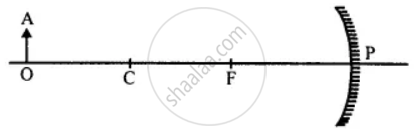
An object OA is placed on the principal axis of a concave mirror as shown in the figure. Copy and complete the diagram to show the formation of image.
State whether the following statement is true or false. If false, correct it.
If a ray of light incident on a plane mirror is such that it makes an angle of 30o with the mirror, then the angle of reflection is 60o.
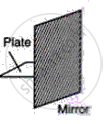
The word PLATE written on a paper is held in front of a plane mirror. Write down the letters as seen in the following case.
The paper is held perpendicular to the mirror.
Reflection occurs , when the light
______ through which light cannot pass.
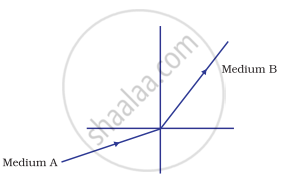
A light ray enters from medium A to medium B as shown in Figure 10.2. The refractive index of medium B relative to A will be
We can see objects because of ______.
Play with a mirror
Write your name with a sketch pen on a thin sheet of paper, polythene or glass. Read your name on the sheet while standing in front of a plane mirror. Now look at your image in the mirror.
