Advertisements
Advertisements
प्रश्न
Why does a light ray incident on a rectangular glass slab immersed in any medium emerges parallel to itself? Explain using a diagram.
Advertisements
उत्तर
Consider the diagram shown below in which EO is incident ray, OO' is refracted ray and O'H is emergent ray.

Here, AB is the air-glass interface and CD is the glass-air interface. The extent of bending of ray of light at opposite and parallel faces AB and CD of the rectangular glass slab is equal and opposite.
Here, angle i1 = r2 and angle r1 = i2
Hence, the ray emerges parallel to the incident ray.
APPEARS IN
संबंधित प्रश्न
Fill in the blank
A plane mirror _________ reflects 100 percent light falling on it.
How is a plane mirror made ?
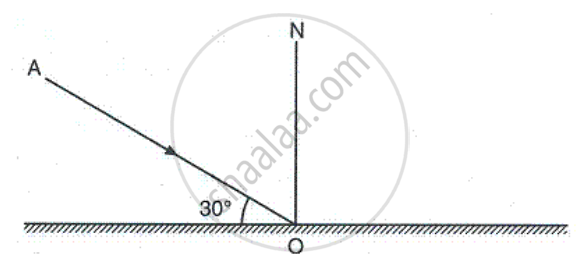
Figure shows an incident ray AO and the normal ON on a plane mirror. The angle which the incident ray AO makes with mirror is 30°. (a) Find the angle of incidence. (b) Draw the reflected ray and then find the angle between the incident and reflected rays.
The diagram in Figure shows a point object P in front of a plane mirror MM1.
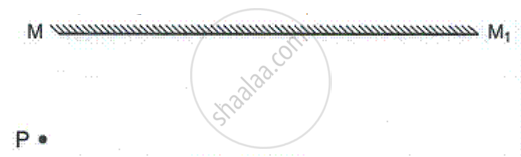
(a) Complete the diagram by taking two rays from the point P to show the formation of its image.
(b) In the diagram, mark the position of eye to see the image.
(c) Is the image formed real or virtual? Explain why?
A ray is incident on a plane mirror . Its reflected ray is perpandicular to the incident ray . Find the angle of incidence .
Copy the figure. By taking two rays from point A, show the formation of image. State four characteristics of the image.
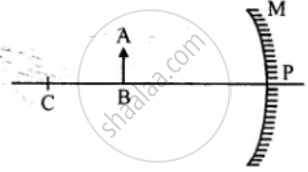
Does the mirror named by you above give real images for all locations of object?
The reflection of a ray of light (OA) normally incident on a plane mirror is shown below
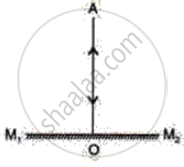
What are the angles of incidence and reflection?
Find the odd one.
glass bottle, exam pad, paper plate, wooden board
Define reflection.
A ray of light is travelling in a direction perpendicular to the boundary of a parallel glass slab. The ray of light ______.
Beams of light are incident through the holes A and B and emerge out of box through the holes C and D respectively as shown in the Figure Which of the following could be inside the box?

Select the WRONG statement in case of image formed by a plane mirror.
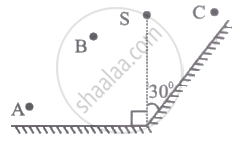
A point source of light S is placed in front of two large mirrors as shown. Which of the following observers will see only one image of S?