Advertisements
Advertisements
प्रश्न
A pencil when dipped in water in a glass tumbler appears to be bent at the interface of air and water. Will the pencil appear to be bent to the same extent, if instead of water we use liquids like, kerosene or turpentine. Support your answer with reason.
Advertisements
उत्तर
The pencil when dipped in water in a glass tumbler appears to be bent at the interface of air and water due to the refraction of light. The refractive index of different mediums is different. The refractive index of kerosene and turpentine is more than the water, due to this the pencil will appear to bend more in case of kerosene or turpentine than that in case of water.
Therefore the pencil will not appear to be bent to the same extent, if instead of water we use liquids like, kerosene or turpentine.
APPEARS IN
संबंधित प्रश्न
| Column I | Column II | Column III | |
| 1 | Dispersion | Long-sightedness | Twinkling of stars |
| 2 | Refraction | Splitting of white light into component colours | Convex lens |
| 3 | Hypermetropia | Change in the direction of the ray of light due to change in medium | Spectrum of seven colours |
Which property of light makes a pencil cast a shadow when it is held in front of a light source?
The letter F is placed in front of a plane mirror:
- How would its image look like when seen in a plane mirror?
- What is the name of the phenomenon involved?
Write the word AMBULANCE as it would appear when reflected in a plane mirror. Why is it sometimes written in this way (as its mirror image) on the front of an ambulance?
Which type of reflection of light leads to the formation of images?
Explain why, though both a plane mirror and a sheet of paper reflect light but we can see the image of our face in a plane mirror but not in a sheet of paper.
State two effects caused by the refraction of light.
A coin in a glass tumbler appears to rise as the glass tumbler is slowly filled with water. Name the phenomenon responsible for this effect.
Water is optically .......... than air.
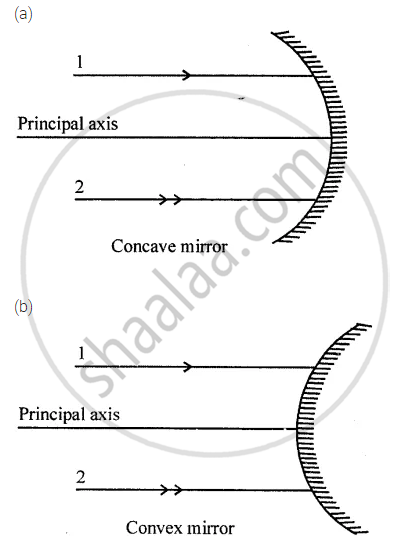
The diagram (figure) given below shows two parallel rays 1 and 2 incident on (a) a concave mirror, (b) a convex mirror. Draw the reflected rays and mark the focus by the symbol F.
The size of image of an object by a convex lens of focal length 20 cm is observed to be reduced to `1/3` rd of its size . Find the distance of the object from the optical centre of the lens .
A real image is formed by the light rays after reflection or refraction when they:
- actually meet or intersect with each other.
- actually converge at a point.
- appear to meet when they are produced in the backward direction.
- appear to diverge from a point.
Which of the above statements are correct?
The phenomenon of light passing through the object is called ______.
Light is refracted or bent while going from one medium to another because of its ______ changes.
Twinkling of stars and Mirage are the two phenomena occurring due to refraction.
Under what circumstances there won’t be any refraction of light when it enters from one medium to another?
Match the following:
| Column I | Column II | ||
| 1. | r > 90 | a. | Light gazes at the surface of separation between the two modes. |
| 2. | r = 90 | b. | No refraction. |
| 3. | r < 90 | c. | Refracted ray away from the normal |
When a ray of light travels normal to the given surface, then the angle of refraction is ______.
Which of the following relations is called Snell's Law?
