Advertisements
Advertisements
Question
Explain the working of a periscope.
Advertisements
Solution
Periscope:
- It is an instrument used for viewing bodies or ships, which are over and around another body or a submarine.
- It is based on the principle of the law of reflection of light.
- It consists of a long outer case and inside this case mirrors or prisms are kept at each end, inclined at an angle of 45°.
- Light coming from the distant body falls on the mirror at the top end of the periscope and gets reflected vertically downward.
- This light is reflected again by the second mirror kept at the bottom, so as to travel horizontally and reach the eye of the observer.
- In some complex periscopes, optic fiber is used instead of mirrors for obtaining a higher resolution.
- The distance between the mirrors also varies depending on the purpose of using
APPEARS IN
RELATED QUESTIONS
The image in a plane mirror is virtual and laterally inverted. What does this statement mean?
Name the phenomenon due to which a swimming pool appears less deep than it really is.
When a ray of light passes from air into glass, is the angle of refraction greater than or less than the angle of incidence?
A ray of light passes from a medium X to another medium Y. No refraction of light occurs if the ray of light hits the boundary of medium Y at an angle of:
(a) 0°
(b) 45°
(c) 90°
(d) 120°
The depth of a pond when seen from above appears to be less.
Draw a diagram showing the refraction of a light ray from water to glass. Label on it the incident ray, the angle of incidence (/), and the angle of refraction (r)
Light changes its direction when going from one transparent medium to another transparent medium. This is called _______.
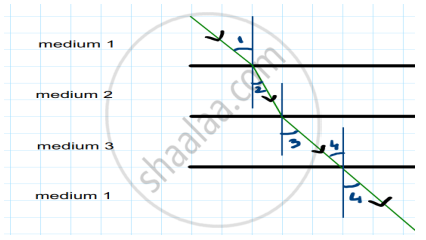
In the above diagram light is travelling through different media. It is noted by a scientist that ∠1= ∠3 = ∠4 but ∠2 < ∠1. Which of the following statement would be correct?
Assertion: The air bubble shines in water.
Reason: Air bubble shines due to the refraction of light.
How do twinkling stars occur? (or) what is the cause of the twinkling of stars?
