Advertisements
Advertisements
प्रश्न
Explain how to read the following message which was found on some blotting paper:
Advertisements
उत्तर
Place a plane mirror in front of the message and see the image of the message. The mirror now reads as 'meet me at midnight'. The phenomenon of lateral inversion is used here..
APPEARS IN
संबंधित प्रश्न
If an object is placed at a distance of 10 cm in from of a plane mirror, how far would it be from its image?
A wall reflects light and a mirror also reflects light. What difference is three in the way they reflect light?
Which type of reflection of light leads to the formation of images?
The image formed by a plane mirror is :
(a) virtual, behind the mirror and enlarged.
(b) virtual, behind the mirror and of the same size as the object.
(c) real, at the surface of the mirror and enlarged.
(d) real, behind the mirror and of the same size as the object.
Light travels more quickly through water than through glass.
Which is optically denser : water or glass?
Light travels more quickly through water than through glass.
If a ray of light passes from glass into water, which way will it bend : towards the normal or away from the normal?
Show the lateral displacement of the ray on the diagram.
A vertical ray of light strikes the horizontal surface of some water:
What is the angle of incidence?
When a ray of light travels from air to glass, it bends .......... the normal.
A ray of light A incident from air suffers partial reflection and refraction at the boundary of water.
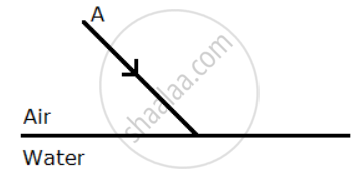
- Complete the diagram showing (i) the reflected ray B and (ii) the refracted ray C.
- How are the angles of incidence i and refraction r related?
A small air bubble in a glass block when seen from above appears to be raised because of ______.
A real image is formed by the light rays after reflection or refraction when they:
- actually meet or intersect with each other.
- actually converge at a point.
- appear to meet when they are produced in the backward direction.
- appear to diverge from a point.
Which of the above statements are correct?
Write scientific reason.
The bottom of a pond appears raised.
Explain the working of a periscope.
Numerical problems.
The speed of light in water is 2.25 × 10⁸ ms–1. If the speed of light in vacuum is 3 × 10⁸ ms–1, calculate the refractive index of water.
The refractive index of four substances A, B, C, and D are 1.31, 1.43, 1.33, 2.4 respectively. The speed of light is maximum in
The refractive index of a transparent medium is always greater than ______.
A ray of light traveling in medium 1 strikes and travels into another transparent medium 2. If the speed of light is greater in medium 1, the ray will ______.
A water tank appears shallower when it is viewed from the top due to refraction.
Why a pencil partly immersed in water appears to be bent at the water surface.
