Advertisements
Advertisements
Questions
Write a scientific reason.
The coin disappears in a vessel as it is seen from a specific location. But as soon as the water is poured into the vessel to a certain level, the coin appears.
Write a scientific reason.
The coin in the disappeared to have been seen from a specific location. But as soon as the water is poured into the pot to a certain level, the coin appears.
Advertisements
Solution
- Light rays coming from the coin emerge out of water and change their direction due to the refraction of light.
- Hence, as soon as the water is poured into the pot to a certain level, the coin appears.
APPEARS IN
RELATED QUESTIONS
A ray of light strikes a plane mirror such that its angle of incidence is 30°. What angle does the reflected ray make with the mirror surface?
What is lateral inversion? Explain by giving a suitable example.
What type of reflection of light takes place from a cinema screen?
What is meant by 'reflection of light'?
An object is placed 20 cm in front of a plane mirror. The mirror is moved 2 cm towards the object. The distance between the positions of the positions of the original and final images seen in the mirror is ______.
A ray of light travelling in glass emerges into air. State whether it will bend towards the normal or away from the normal.
Name the phenomenon due to which a swimming pool appears less deep than it really is.
State whether the following statement is true or false:
Refraction occurs because light slows down in denser materials.
Fill in the following blank with suitable word:
Light travelling along a normal is ...............refracted.
A ray of light travelling in air is incident on a rectangular glass block and emerges out into the air from the opposite face. Draw a labelled ray diagram to show the completer path of this ray of light. Mark the two points where the refraction of light takes place. What can you say about the final direction of ray of light?
Light travels more quickly through water than through glass.
- Which is optically denser: water or glass?
- If a ray of light passes from glass into water, which way will it bend: towards the normal or away from the normal?
When a light ray passes from air into glass, what happens to its speed? Draw a diagram to show which way the ray of light bends.
Show the lateral displacement of the ray on the diagram.
When a ray of light travelling in glass enters into water obliquely ______.
A ray of light passes from a medium X to another medium Y. No refraction of light occurs if the ray of light hits the boundary of medium Y at an angle of:
(a) 0°
(b) 45°
(c) 90°
(d) 120°
Water is optically denser than glass.
Light travels at a lower speed in water than in air.
Water is optically .......... than air.
What do you understand by refraction of light?
What is the cause of refraction of light when it passes from one medium to another?
A ray of light passes from medium 1 to medium 2. Which of the following quantities of the refracted ray will differ from that of the incident ray: Speed, intensity, frequency, wavelength?
A ray of light A incident from air suffers partial reflection and refraction at the boundary of water.
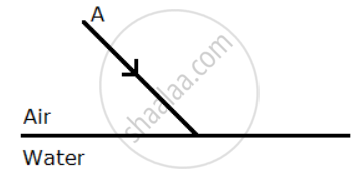
- Complete the diagram showing (i) the reflected ray B and (ii) the refracted ray C.
- How are the angles of incidence i and refraction r related?
Fill in the blank and Explain the completed sentences.
The change in ______ of light rays while going from one medium to another is called refraction.
The size of image of an object by a convex lens of focal length 20 cm is observed to be reduced to `1/3` rd of its size . Find the distance of the object from the optical centre of the lens .
Write scientific reason.
The bottom of a pond appears raised.
The deviation of light ray from its path when it travels from one transparent medium to another transparent medium is called ______.
If a beam of red light and a beam of violet light are incident at the same angle on the inclined surface of a prism from air medium and produce angles of refraction r and v respectively, which of the following is correct?

The angle of incidence from air to glass at the point O on the hemispherical glass slab is.
A pencil when dipped in water in a glass tumbler appears to be bent at the interface of air and water. Will the pencil appear to be bent to the same extent, if instead of water we use liquids like, kerosene or turpentine. Support your answer with reason.
Which surface will not reflect most of the light falling on them?
How does the light travel?
Light travels fastest in a vacuum. Why?
A star appears twinkling into the sky because of the reflection of light by the atmosphere.
Twinkling of stars and Mirage are the two phenomena occurring due to refraction.
When light travels from a denser medium to a rarer medium, its speed:
Which of the following relations is called Snell's Law?
A larger refractive index of a medium means that light travels:
