Advertisements
Advertisements
Question
Write scientific reason.
The sun appears on the western horizon for some time after sunset.
Advertisements
Solution
- As ray of light from the Sun enters the earth’s atmosphere, it follows a curved path due to refraction, before reaching the observer.
- This makes the apparent position of the Sun slightly higher than the actual position for the observer.
- Hence, due to the atmospheric refraction of sunlight, the observer on the earth continues to see the setting Sun for two minutes after the Sun has dipped below the horizon, thus delaying the sunset.
APPEARS IN
RELATED QUESTIONS
Name the phenomenon responsible for the following effect:
When we sit in front of a plane mirror and write with our right hand, it appears in the mirror that we are writing with the left hand.
If an object is placed at a distance of 10 cm in from of a plane mirror, how far would it be from its image?
Where is the image when you look at something in a mirror?
Write the word AMBULANCE as it would appear when reflected in a plane mirror. Why is it sometimes written in this way (as its mirror image) on the front of an ambulance?
A boy with a mouth 5 cm wide stands 2 m away from a plane mirror. Where is his image and how wide is the image of his mouth?
State the uses of plane mirrors.
The image formed by a plane mirror is :
(a) virtual, behind the mirror and enlarged.
(b) virtual, behind the mirror and of the same size as the object.
(c) real, at the surface of the mirror and enlarged.
(d) real, behind the mirror and of the same size as the object.
The figure given alongside shows the image of a clock as seen in a plane mirror. The correct time is:
If a ray of light goes from a rarer medium to a denser medium, will it bend towards the normal or away from it?
A ray of light passes from air into a block of glass. Does it bend towards the normal or away from it?
State whether the following statement is true or false:
Refraction occurs because light slows down in denser materials.
Light travels more quickly through water than through glass.
- Which is optically denser: water or glass?
- If a ray of light passes from glass into water, which way will it bend: towards the normal or away from the normal?
Light travels more quickly through water than through glass.
If a ray of light passes from glass into water, which way will it bend : towards the normal or away from the normal?
With the help of a labelled diagram, explain why a tank full of water appears less deep than it actually is.
- With the help of a diagram, show how when light falls obliquely on the side of a rectangular glass slab, the emergent ray is parallel to the incident ray.
- Show the lateral displacement of the ray on the diagram.
A vertical ray of light strikes the horizontal surface of some water:
What is the angle of refraction?
Match the Following
| Column A | Column B |
| (a) white Light | (1) Convex mirror |
| (b) Refraction | (2) Concave mirror |
| (c) Virtual images | (3) refraction |
| (d) Real images | (4) spectrum |
| (e) Prism | (5) ray of light from glass to air |
A small air bubble in a glass block when seen from above appears to be raised because of ______.
We can see the sun even when it is little below the horizon because of ______.
Light enters from air to glass having refractive index 1.50. What is the speed of light in the glass? The speed of light in vacuum is 3 × 10⁸ m s−1.
The phenomenon of change in the direction of light when it passes from one transparent medium to another is called ___________.
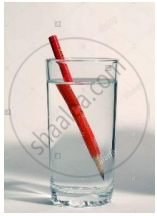
Due to _______ pencil looks bent in water, in the given experiment.
Light changes its direction when going from one transparent medium to another transparent medium. This is called _______.
The refractive index of a transparent medium is always greater than ______.
Assertion and reasoning type
- Assertion: If the refractive index of the medium is high (denser medium) the velocity of the light in that medium will be small
- Reason: Refractive index of the medium is inversely proportional to the velocity of the light
The deviation of light ray from its path when it travels from one transparent medium to another transparent medium is called ______.
If a beam of red light and a beam of violet light are incident at the same angle on the inclined surface of a prism from air medium and produce angles of refraction r and v respectively, which of the following is correct?
The phenomenon of light passing through the object is called ______.
The bending of light as it passes from one medium to another is called ______.
The bottom of swimming pool appears to be less deep than the actual one because of
When a light ray passes from a rarer medium to a denser medium, it bends:
Which of the following relations is called Snell's Law?
The absolute refractive index of a medium is given by:
In the formula for absolute refractive index \[n = \frac{c}{v}\], the quantity c represents:
To a crane, a fish appears 6 cm below the water surface. Taking the refractive index of water as \[\frac{4}{3}\], the real depth of the fish below the surface is:
