Advertisements
Advertisements
प्रश्न
A ray of light travelling in air is incident on a rectangular glass block and emerges out into the air from the opposite face. Draw a labelled ray diagram to show the completer path of this ray of light. Mark the two points where the refraction of light takes place. What can you say about the final direction of ray of light?
Advertisements
उत्तर

Here, light ray changes its direction or refracts at point A when it travels from air to glass. The ray changes its direction again at point B when it travels from glass to air.
The final direction of light ray, i.e., BX will be parallel to the direction OAY in which it enters the glass block.
APPEARS IN
संबंधित प्रश्न
What are the important differences between looking at a photograph of your face and looking at yourself in a plane mirror?
A wall reflects light and a mirror also reflects light. What difference is three in the way they reflect light?
A man stands 10 m in front of a large plane mirror. How far must the walk before he is 5 m away from his image?
If a ray of light goes from a rarer medium to a denser medium, will it bend towards the normal or away from it?
What is meant by ‘refraction of light’?
When a light ray passes from air into glass, what happens to its speed? Draw a diagram to show which way the ray of light bends.
When a ray of light travels from air to glass, it bends .......... the normal.
Draw suitable diagrams to illustrate how a beam of light incident parallel to the principal axis is reflected by:
(a) a concave mirror, and (b) a convex mirror
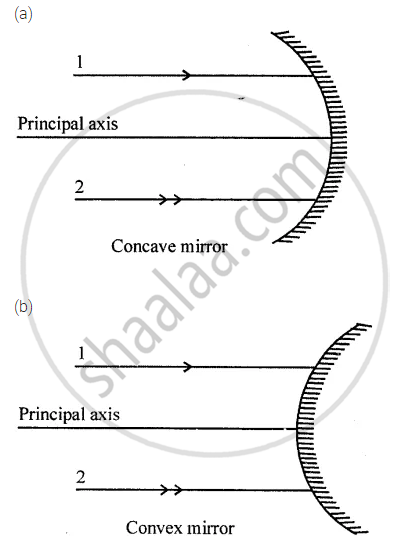
The diagram (figure) given below shows two parallel rays 1 and 2 incident on (a) a concave mirror, (b) a convex mirror. Draw the reflected rays and mark the focus by the symbol F.
The laws of reflection hold true for ______.
If a beam of red light and a beam of violet light are incident at the same angle on the inclined surface of a prism from air medium and produce angles of refraction r and v respectively, which of the following is correct?
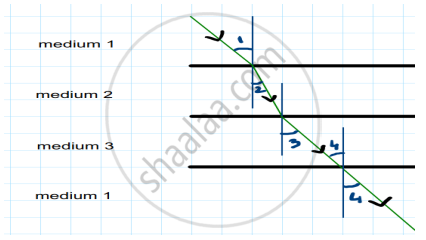
In the above diagram light is travelling through different media. It is noted by a scientist that ∠1= ∠3 = ∠4 but ∠2 < ∠1. Which of the following statement would be correct?
The bending of light as it passes from one medium to another is called ______.
The ratio of the sine of the angle of incidence to the sine of ______ is constant.
When light passes from one transparent medium to another, its direction changes due to:
When a light ray passes from a rarer medium to a denser medium, it bends:
In the formula for absolute refractive index \[n = \frac{c}{v}\], the quantity c represents:
To a crane, a fish appears 6 cm below the water surface. Taking the refractive index of water as \[\frac{4}{3}\], the real depth of the fish below the surface is:
