Advertisements
Advertisements
प्रश्न
The speed of light varies in different media.
विकल्प
Right
Wrong
Advertisements
उत्तर
The speed of light varies in different media- Right
APPEARS IN
संबंधित प्रश्न
What is refraction of light?
The letter F is placed in front of a plane mirror:
- How would its image look like when seen in a plane mirror?
- What is the name of the phenomenon involved?
Write the word AMBULANCE as it would appear when reflected in a plane mirror. Why is it sometimes written in this way (as its mirror image) on the front of an ambulance?
Which type of reflection of light leads to the formation of images?
What is the difference between regular reflection of light and diffuse reflection of light?
If a ray of light goes form a denser medium to a rarer medium, will it bend towards the normal or away from the normal?
A ray of light travelling in glass emerges into air. State whether it will bend towards the normal or away from the normal.
Name the phenomenon due to which a swimming pool appears less deep than it really is.
What is meant by the ‘angle of incidence’ for a ray of light?
A coin in a glass tumbler appears to rise as the glass tumbler is slowly filled with water. Name the phenomenon responsible for this effect.
Draw suitable diagrams to illustrate how a beam of light incident parallel to the principal axis is reflected by:
(a) a concave mirror, and (b) a convex mirror
Light enters from air to glass having refractive index 1.50. What is the speed of light in the glass? The speed of light in vacuum is 3 × 10⁸ m s−1.
Explain how the formation of a rainbow occurs.
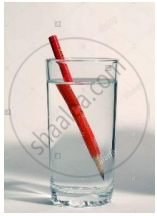
Due to _______ pencil looks bent in water, in the given experiment.
Lights of different colours are used as signal for safety transport. From these, the wavelength of red light is _______ nm.
Write scientific reason.
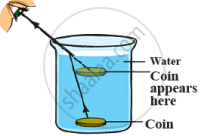
The bottom of a pond appears raised.
Write scientific reason.
A pencil appears to be broken near the surface of water.
Observe the given figure and name the following.
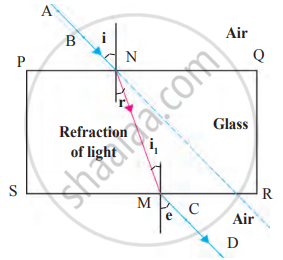
| Ray AB | |
| Ray NM | |
| Ray MD | |
| ∠ r |
Observe the given figure and write appropriate phenomenon of light in the box.
Numerical problems.
The speed of light in water is 2.25 × 10⁸ ms–1. If the speed of light in vacuum is 3 × 10⁸ ms–1, calculate the refractive index of water.
What is refractive index?
The angle of incidence for a ray of light having zero reflection angle is ______.
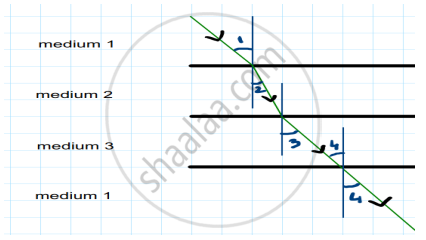
In the above diagram light is travelling through different media. It is noted by a scientist that ∠1= ∠3 = ∠4 but ∠2 < ∠1. Which of the following statement would be correct?
Noor, a young student, was trying to demonstrate some properties of light in her Science project work. She kept ‘X’ inside the box (as shown in the figure) and with the help of a laser pointer made light rays pass through the holes on one side of the box. She had a small butter-paper screen to see the spots of light being cast as they emerged.

Her friend noted the following observations from this demonstration:
- Glass is optically rarer than air.
- Air and glass allow light to pass through them with the same velocity.
- Air is optically rarer than glass.
- Speed of light through a denser medium is faster than that of a rarer medium.
- The ratio: sin of angle of incidence in the first medium to the ratio of sin of angle of refraction in the second medium, gives the refractive index of the second material with respect to the first one.
Which one of the combinations of the above statements given below is correct.
Which object use the reflection of light?
Which surface will not reflect most of the light falling on them?
How does the light travel?
Light bends as it passes from one medium to another. What is this phenomenon called?
The ratio of the sine of the angle of incidence to the sine of ______ is constant.
Light is refracted or bent while going from one medium to another because of its ______ changes.
A water tank appears shallower when it is viewed from the top due to refraction.
Assertion: The air bubble shines in water.
Reason: Air bubble shines due to the refraction of light.
How do twinkling stars occur? (or) what is the cause of the twinkling of stars?
When a ray of light travels normal to the given surface, then the angle of refraction is ______.
The change in the direction of the path of light when it passes from one transparent medium to another transparent medium is called:
The ray that enters the second medium after crossing the boundary is called the:
When a light ray passes from a denser medium to a rarer medium, it bends:
When a ray of light is incident along the normal on the surface separating two media:
