Advertisements
Advertisements
प्रश्न
The laws of reflection hold true for ______.
विकल्प
plane mirrors only
concave mirrors only
convex mirrors only
all reflecting surfaces
Advertisements
उत्तर
The laws of reflection hold true for all reflecting surfaces.
Explanation:
The laws of reflection are fundamental principles of optics that describe how light behaves when it hits a surface. These laws state:
- The angle of incidence is equal to the angle of reflection.
- The incident ray, the reflected ray, and the normal to the surface at the point of incidence all lie in the same plane.
संबंधित प्रश्न
Light travels more quickly through water than through glass.
- Which is optically denser: water or glass?
- If a ray of light passes from glass into water, which way will it bend: towards the normal or away from the normal?
Explain with the help of a labelled ray diagram, why a pencil partly immersed in water appears to be bent at the water surface. State whether the bending of pencil will increase or decrease if water is replaced by another liquid which is optically more dense than water. Give reason for your answer.
Water is optically .......... than air.
Observe the given figure and name the following.
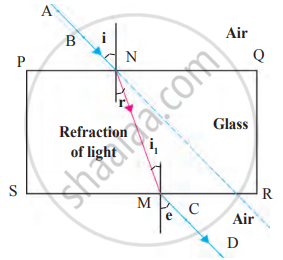
| Ray AB | |
| Ray NM | |
| Ray MD | |
| ∠ r |
Noor, a young student, was trying to demonstrate some properties of light in her Science project work. She kept ‘X’ inside the box (as shown in the figure) and with the help of a laser pointer made light rays pass through the holes on one side of the box. She had a small butter-paper screen to see the spots of light being cast as they emerged.

Her friend noted the following observations from this demonstration:
- Glass is optically rarer than air.
- Air and glass allow light to pass through them with the same velocity.
- Air is optically rarer than glass.
- Speed of light through a denser medium is faster than that of a rarer medium.
- The ratio: sin of angle of incidence in the first medium to the ratio of sin of angle of refraction in the second medium, gives the refractive index of the second material with respect to the first one.
Which one of the combinations of the above statements given below is correct.
The bending of light as it passes from one medium to another is called ______.
Assertion: The air bubble shines in water.
Reason: Air bubble shines due to the refraction of light.
The bottom of swimming pool appears to be less deep than the actual one because of
When light travels from a rarer medium to a denser medium, its speed:
Which of the following relations is called Snell's Law?
