Advertisements
Advertisements
प्रश्न
Calculate the speed of light in a medium whose critical angle is 30° ?
Advertisements
उत्तर
Speed of light in the medium =`\text { Speed of light in air}/ text { Refractive index of the medium with respet to air}`
`=(3 xx 10^8 m/s)/(1/(sin30°)`
`= (3 xx 10^8 m/s)/2`
`=1.5 xx 10^8m/s`
APPEARS IN
संबंधित प्रश्न
A ray of light travels from water to air as shown in the diagram given below :
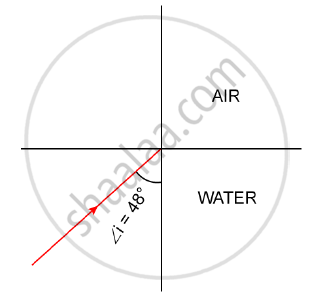
1) Copy the diagram and complete the path of the way. Given the critical angle for water is 48°.
2) State the condition so that internal reflection occurs in the above diagram.
The diagram below shows a point source P inside a water container. Four rays A, B, C, D starting from the source P, are shown up to the water surface.
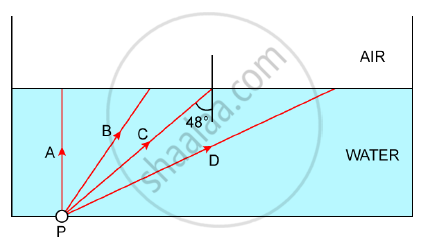
- Show in the diagram the path of these rays after striking the water surface. The Critical Angle for the water-air surface is 48°.
- Name the phenomenon which the rays B and D exhibit.
Name the factors affecting the critical angle for the pair of media.
Write the relation between the refractive index and critical angle for a given pair of optical media?
Swarali has got the following observations while doing an experiment. Answer her questions with the help of observations.
Swarali observed that the light bent away from the normal, while travelling from dense medium to rarer medium. When Swarali increased the values of angle of incidence (i), the values of angle of refraction (r) went on increasing. But at a certain angle of incidence, the light rays returned into the dense medium.
So, Swarali has some questions. Answer them –
a) Name this certain value of ‘i ’. What is the value of ‘r’ at that time ?
b) Name this process of returning of light in dense medium. Explain the process.
How does a ray of light bend when it travels from when it is normal to the interface of the two media.
The entire light is reflected back into the denser medium is called ______.
A ray of light passes through a prism of refractive index `sqrt2` as shown in the figure. Find:
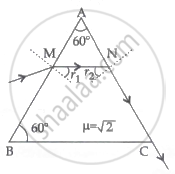
- The angle of incidence (∠r2) at face AC.
- The angle of minimum deviation for this prism.
A ray of light passes from vacuum into a medium of refractive index µ, the angle of incidence is found to be twice the angle of refraction. Then the angle of incidence is ______.
The critical angle for crown glass, which has a refractive index of 1.52, is:
