Advertisements
Advertisements
प्रश्न
With the help of a ray diagram, obtain the relation between its focal length and radius of curvature.
Advertisements
उत्तर १
The distance between the centre of a lens or curved mirror and its focus.
The relationship between the focal length f and the radius of curvature R = 2f.
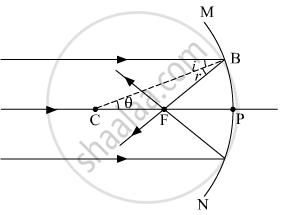
Consider a ray of light AB, parallel to the principal axis and incident on a spherical mirror at point B. The normal to the surface at point B is CB, and CP = CB = R is the radius of curvature. The ray AB, after reflection from a mirror, will pass through F (concave mirror) or will appear to diverge from F (convex mirror) and obeys the law of reflection, i.e., i = r.
From the geometry of the figure,
∠BCP = θ = i
In DCBF, θ = r
∴ BF = FC (because i = r)
If the aperture of the mirror is small, B lies close to P,
∴ BF = PF
Or, FC = FP = PF
Or, PC = PF + FC = PF + PF
Or, R = 2 PF = 2f
Or, f = R/2
A similar relation holds for a convex mirror also. In deriving this relation, we have assumed that the aperture of the mirror is small.
उत्तर २
A ray of light BP' travelling parallel to the principal axis PC is incident on a spherical mirror PP'. It reflects along P'R.
For a concave mirror, it passes through the focus. For a convex mirror, extending the ray backward, it appears to pass through the focus.
P is the pole and Fis the focus of the mirror.
PF = f
C is the centre of curvature.
PC = radius of curvature = R
P'C is the normal to the mirror at the point of incidence P'.
For a concave mirror,
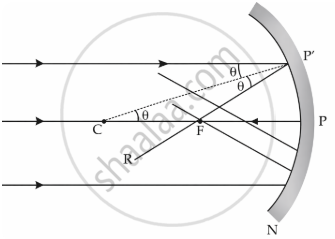
∠BP'C = ∠P'CF = θ ...[alternate angles]
and ∠BP'C = ∠CP'F = θ ...[law of reflection, ∠i = ∠r]
Hence ∠P'CF = ∠CP'F
∴ ΔFP'C is isosceles.
Hence, P'F = FC
If the aperture of the mirror is small, the point P' is very close to the point P, then:
P'F = PF
∴ PF = FC
= `1/2 PC`
∴ f = `1/2 R`
संबंधित प्रश्न
A small candle, 2.5 cm in size is placed at 27 cm in front of a concave mirror of radius of curvature 36 cm. At what distance from the mirror should a screen be placed in order to obtain a sharp image? Describe the nature and size of the image. If the candle is moved closer to the mirror, how would the screen have to be moved?
If an object far away from a convex mirror moves towards the mirror, the image also moves. Does it move faster, slower or at the same speed as compared to the object?
A diverging lens of focal length 20 cm and a converging mirror of focal length 10 cm are placed coaxially at a separation of 5 cm. Where should an object be placed so that a real image is formed at the object itself?
A converging lens of focal length 40 cm is kept in contact with a diverging lens of focal length 30 cm. Find the focal length of the combination .
How can the spherical aberration produced by a lens be minimized?
According to the mirror equation, ______.
An object is 20 cm away from a concave mirror and it is within the focal length of the mirror. If the mirror is changed to a plane mirror, the image moves 15 cm closer to the mirror.
Focal length of the concave mirror is ______.
A lens of focal length f is divided into two equal parts and then these parts are put in a combination as shown in the figure below.
- What is the focal length of L1?
- What is the focal length of the final combination?

The angle of reflection is the angle between:
The laws of reflection are valid:
