Advertisements
Advertisements
प्रश्न
(i) Consider a thin lens placed between a source (S) and an observer (O) (Figure). Let the thickness of the lens vary as `w(b) = w_0 - b^2/α`, where b is the verticle distance from the pole. `w_0` is a constant. Using Fermat’s principle i.e. the time of transit for a ray between the source and observer is an extremum, find the condition that all paraxial rays starting from the source will converge at a point O on the axis. Find the focal length.

(ii) A gravitational lens may be assumed to have a varying width of the form
`w(b) = k_1ln(k_2/b) b_("min") < b < b_("max")`
= `k_1ln (K_2/b_("min")) b < b_("min")`
Show that an observer will see an image of a point object as a ring about the center of the lens with an angular radius
`β = sqrt((n - 1)k_1 u/v)/(u + v)`
Advertisements
उत्तर
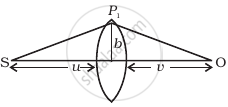
(i) The time required to travel from S to P1 is `t_1 = (SP_1)/c = sqrt(u^2 + b^2)/c ≃ u/c (1 + 1/2 b^2/u^2)` assuming b << u0
The time required to travel from P1 to O is `t_2 = (P_1O)/c = sqrt(v^2 + b^2)/c ≃ v/c(1 + 1/2 b^2/v^2)`
The time required to travel through the lens is `t_1 = ((n - 1)w(b))/c` where n is the refractive index.
Thus the total time is `t = 1/c[u + v + 1/2 b^2 (1/u + 1/v) + (n - 1)w(b)]`
Put `1/D = 1/u + 1/v`
Then `t = 1/c(u + v + 1/2 b^2/D + (n - 1)(w_0 + b^2/α))`
Fermet’s principle gives
`(dt)/(db) = 0 = b/(CD) - (2(n - 1)b)/(cα)`
α = `2(n - 1)D`
Thus a convergent lens is formed if α = 2(n – 1)D. This is independent of b and hence all paraxial rays from S will converge at O (i.e. for rays b << n and b << v).
Since `1/D = 1/u + 1/v`, the focal length is D.
(ii) In this case
`t = 1/c(u + v + 1/2 b^2/D + (n - 1) k_1ln (k_2/b))`
`(dt)/(db) = 0 = b/D - (n - 1) k_1/b`
⇒ b2 = `(n - 1) k_1D`
∴ b = `sqrt((n - 1)k_1D`
Thus all rays passing at a height b shall contribute to the image. The ray paths make an angle
`β ≃ b/v = sqrt((n - 1)k_1D)/v^2 = sqrt(((n - 1)k_1uv)/(v^2(u + v))) = sqrt(((n - 1)k_1u)/((u + v)v))`.
APPEARS IN
संबंधित प्रश्न
A small candle, 2.5 cm in size is placed at 27 cm in front of a concave mirror of radius of curvature 36 cm. At what distance from the mirror should a screen be placed in order to obtain a sharp image? Describe the nature and size of the image. If the candle is moved closer to the mirror, how would the screen have to be moved?
A 4.5 cm needle is placed 12 cm away from a convex mirror of focal length 15 cm. Give the location of the image and the magnification. Describe what happens as the needle is moved farther from the mirror.
In motor vehicles, a convex mirror is attached near the driver's seat to give him the view of the traffic behind. What is the special function of this convex mirror which a plane mirror can not do?
Can mirrors give rise to chromatic aberration?
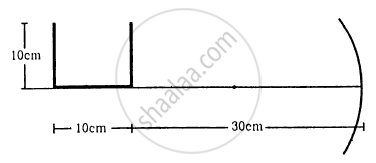
A U-shaped wire is placed before a concave mirror having radius of curvature 20 cm as shown in figure. Find the total length of the image.
The image of an extended object, placed perpendicular to the principal axis of a mirror, will be erect if
(a) the object and the image are both real
(b) the object and the image are both virtual
(c) the object is real but the image is virtual
(d) the object is virtual but the image is real.
Light is incident from glass (μ = 1.5) to air. Sketch the variation of the angle of deviation δ with the angle of incident i for 0 < i < 90°.
A narrow pencil of parallel light is incident normally on a solid transparent sphere of radius r. What should be the refractive index is the pencil is to be focussed (a) at the surface of the sphere, (b) at the centre of the sphere.
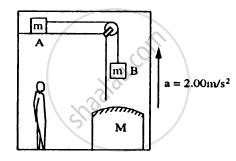
Consider the situation shown in figure. The elevator is going up with an acceleration of 2.00 m s−2 and the focal length of the mirror is 12.0 cm. All the surfaces are smooth and the pulley is light. The mass-pulley system is released from rest (with respect to the elevator) at t = 0 when the distance of B from the mirror is 42.0 cm. Find the distance between the image of the block B and the mirror at t = 0.200 s. Take g = 10 m s−2.
A converging lens of focal length 40 cm is kept in contact with a diverging lens of focal length 30 cm. Find the focal length of the combination .
According to the mirror equation, ______.
The focal length of a convex lens made of glass of refractive index (1.5) is 20 cm.
What will be its new focal length when placed in a medium of refractive index 1.25?
Is focal length positive or negative? What does it signify?
A parallel beam of light ray parallel to the x-axis is incident on a parabolic reflecting surface x = 2by2 as shown in the figure. After reflecting it passes through focal point F. What is the focal length of the reflecting surface?

The intensity of a point source of light, S, placed at a distance d in front of a screen A, is I0 at the center of the screen. Find the light intensity at the center of the screen if a completely reflecting plane mirror M is placed at a distance d behind the source, as shown in the figure.

An astronomical refractive telescope has an objective of focal length 20 m and an eyepiece of focal length 2 cm.
- The length of the telescope tube is 20.02 m.
- The magnification is 1000.
- The image formed is inverted.
- An objective of a larger aperture will increase the brightness and reduce chromatic aberration of the image.
A spherical mirror is obtained as shown in the figure from a hollow glass sphere. if an object is positioned in front of the mirror, what will be the nature and magnification of the image of the object? (Figure drawn as schematic and not to scale)

An object is 20 cm away from a concave mirror and it is within the focal length of the mirror. If the mirror is changed to a plane mirror, the image moves 15 cm closer to the mirror.
Focal length of the concave mirror is ______.
A particle is dropped along the axis from a height 15 cm on a concave mirror of focal length 30 cm as shown in figure. The acceleration due to gravity is 10 m/s2. Find the maximum speed of image in m/s:

A converging lens has a focal length of 10 cm in air. It is made of a material with a refractive index of 1.6. If it is immersed in a liquid of refractive index 1.3, find its new focal length.
