Advertisements
Advertisements
प्रश्न
(i) Consider a thin lens placed between a source (S) and an observer (O) (Figure). Let the thickness of the lens vary as `w(b) = w_0 - b^2/α`, where b is the verticle distance from the pole. `w_0` is a constant. Using Fermat’s principle i.e. the time of transit for a ray between the source and observer is an extremum, find the condition that all paraxial rays starting from the source will converge at a point O on the axis. Find the focal length.

(ii) A gravitational lens may be assumed to have a varying width of the form
`w(b) = k_1ln(k_2/b) b_("min") < b < b_("max")`
= `k_1ln (K_2/b_("min")) b < b_("min")`
Show that an observer will see an image of a point object as a ring about the center of the lens with an angular radius
`β = sqrt((n - 1)k_1 u/v)/(u + v)`
Advertisements
उत्तर
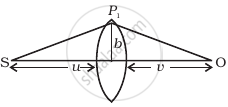
(i) The time required to travel from S to P1 is `t_1 = (SP_1)/c = sqrt(u^2 + b^2)/c ≃ u/c (1 + 1/2 b^2/u^2)` assuming b << u0
The time required to travel from P1 to O is `t_2 = (P_1O)/c = sqrt(v^2 + b^2)/c ≃ v/c(1 + 1/2 b^2/v^2)`
The time required to travel through the lens is `t_1 = ((n - 1)w(b))/c` where n is the refractive index.
Thus the total time is `t = 1/c[u + v + 1/2 b^2 (1/u + 1/v) + (n - 1)w(b)]`
Put `1/D = 1/u + 1/v`
Then `t = 1/c(u + v + 1/2 b^2/D + (n - 1)(w_0 + b^2/α))`
Fermet’s principle gives
`(dt)/(db) = 0 = b/(CD) - (2(n - 1)b)/(cα)`
α = `2(n - 1)D`
Thus a convergent lens is formed if α = 2(n – 1)D. This is independent of b and hence all paraxial rays from S will converge at O (i.e. for rays b << n and b << v).
Since `1/D = 1/u + 1/v`, the focal length is D.
(ii) In this case
`t = 1/c(u + v + 1/2 b^2/D + (n - 1) k_1ln (k_2/b))`
`(dt)/(db) = 0 = b/D - (n - 1) k_1/b`
⇒ b2 = `(n - 1) k_1D`
∴ b = `sqrt((n - 1)k_1D`
Thus all rays passing at a height b shall contribute to the image. The ray paths make an angle
`β ≃ b/v = sqrt((n - 1)k_1D)/v^2 = sqrt(((n - 1)k_1uv)/(v^2(u + v))) = sqrt(((n - 1)k_1u)/((u + v)v))`.
APPEARS IN
संबंधित प्रश्न
A 4.5 cm needle is placed 12 cm away from a convex mirror of focal length 15 cm. Give the location of the image and the magnification. Describe what happens as the needle is moved farther from the mirror.
A double convex lens is made of a glass of refractive index 1.55, with both faces of the same radius of curvature. Find the radius of curvature required, if the focal length is 20 cm.
Can mirrors give rise to chromatic aberration?
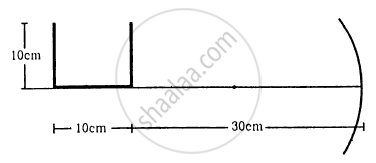
A U-shaped wire is placed before a concave mirror having radius of curvature 20 cm as shown in figure. Find the total length of the image.
A spherical surface of radius 30 cm separates two transparent media A and B with refractive indices 1.33 and 1.48 respectively. The medium A is on the convex side of the surface. Where should a point object be placed in medium A so that the paraxial rays become parallel after refraction at the surface?
A converging lens and a diverging mirror are placed at a separation of 15 cm. The focal length of the lens is 25 cm and that of the mirror is 40 cm. Where should a point source be placed between the lens and the mirror so that the light, after getting reflected by the mirror and then getting transmitted by the lens, comes out parallel to the principal axis?
How can the spherical aberration produced by a lens be minimized?
With the help of a ray diagram, obtain the relation between its focal length and radius of curvature.
According to Cartesian sign convention, all distances are measured from the _______.
According to the mirror equation, ______.
The intensity of a point source of light, S, placed at a distance d in front of a screen A, is I0 at the center of the screen. Find the light intensity at the center of the screen if a completely reflecting plane mirror M is placed at a distance d behind the source, as shown in the figure.

You are given four sources of light each one providing a light of a single colour – red, blue, green and yellow. Suppose the angle of refraction for a beam of yellow light corresponding to a particular angle of incidence at the interface of two media is 90°. Which of the following statements is correct if the source of yellow light is replaced with that of other lights without changing the angle of incidence?
The direction of ray of light incident on a concave mirror is shown by PQ while directions in which the ray would travel after reflection is shown by four rays marked 1, 2, 3 and 4 (figure). Which of the four rays correctly shows the direction of reflected ray?

A short object of length L is placed along the principal axis of a concave mirror away from focus. The object distance is u. If the mirror has a focal length f, what will be the length of the image? You may take L << |v – f|.
An object is 20 cm away from a concave mirror and it is within the focal length of the mirror. If the mirror is changed to a plane mirror, the image moves 15 cm closer to the mirror.
Focal length of the concave mirror is ______.
A particle is dropped along the axis from a height 15 cm on a concave mirror of focal length 30 cm as shown in figure. The acceleration due to gravity is 10 m/s2. Find the maximum speed of image in m/s:

A converging lens has a focal length of 10 cm in air. It is made of a material with a refractive index of 1.6. If it is immersed in a liquid of refractive index 1.3, find its new focal length.
Why does a car driver use a convex mirror as a rear-view mirror?
The geometric centre of a spherical mirror is called its:
The line joining the pole and the centre of curvature of a spherical mirror is called the:
