Advertisements
Advertisements
प्रश्न
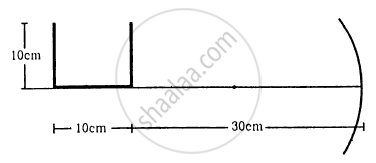
A U-shaped wire is placed before a concave mirror having radius of curvature 20 cm as shown in figure. Find the total length of the image.
Advertisements
उत्तर
Given,
Radius of curvature of concave mirror, R = 20 cm
So its focal length will be f = \[\frac{R}{2}\] = −10 cm
For part AB of the U shaped wire, PB = 30 + 10 = 40 cm
Therefore, u = −40 cm
Using mirror formula,
`1\v = -1/10 - 1/-40 =-3/40`
⇒ `V = -40/3 = 13. 3 cm`
So , PB' = 13.3 cm
`m = (A' B')/( AB ) = -( v )/ u`
\[= \frac{- ( - 13 . 3)}{- 40} = - \frac{1}{3}\]
\[ \Rightarrow A'B' = - \frac{10}{3} = - 3 . 33 \text{ cm }\]
For part CD of the U shaped wire, PC = 30 cm
Therefore, u = −30 cm
Again, using mirror equation:
`1/V = -1/10 - 1/-30`
`1/V = -1/10 + 1/-30 = -1/15`
⇒ v = −15 cm = PC'
\[m = \frac{C'D'}{CD} = - \frac{v}{u}\]
`= -( -15 )/ -30 = -1/2`
⇒ C'D' = 5 cm
⇒ B'C' = PC' − PB'
= 15 − 13.3 = 1.7 cm
Hence, the total length of the U- shaped wire is A'B' + B'C' + C'D'
= (3.3) + (1.7) + 5 = 10 cm
APPEARS IN
संबंधित प्रश्न
Can mirrors give rise to chromatic aberration?
In image formation from spherical mirrors, only paraxial rays are considered because they
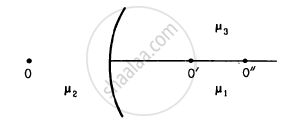
Following figure shows three transparent media of refractive indices \[\mu_1 , \mu_2 \text{ and } \mu_3\]. A point object O is placed in the medium \[\mu_2\]. If the entire medium on the right of the spherical surface has refractive index \[\mu_3\], the image forms at O". In the situation shown,
A narrow pencil of parallel light is incident normally on a solid transparent sphere of radius r. What should be the refractive index is the pencil is to be focussed (a) at the surface of the sphere, (b) at the centre of the sphere.
How can the spherical aberration produced by a lens be minimized?
Answer the following question.
Under what conditions is the phenomenon of total internal reflection of light observed? Obtain the relation between the critical angle of incidence and the refractive index of the medium.
Answer the following question.
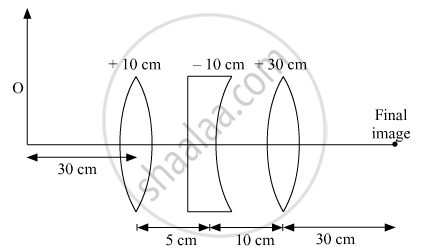
Three lenses of focal length +10 cm, —10 cm and +30 cm are arranged coaxially as in the figure given below. Find the position of the final image formed by the combination.
According to Cartesian sign convention, all distances are measured from the _______.
The intensity of a point source of light, S, placed at a distance d in front of a screen A, is I0 at the center of the screen. Find the light intensity at the center of the screen if a completely reflecting plane mirror M is placed at a distance d behind the source, as shown in the figure.

A car is moving with at a constant speed of 60 km h–1 on a straight road. Looking at the rear view mirror, the driver finds that the car following him is at a distance of 100 m and is approaching with a speed of 5 km h–1. In order to keep track of the car in the rear, the driver begins to glance alternatively at the rear and side mirror of his car after every 2 s till the other car overtakes. If the two cars were maintaining their speeds, which of the following statement (s) is/are correct?
A thin convex lens of focal length 25 cm is cut into two pieces 0.5 cm above the principal axis. The top part is placed at (0, 0) and an object placed at (– 50 cm, 0). Find the coordinates of the image.
A particle is dropped along the axis from a height 15 cm on a concave mirror of focal length 30 cm as shown in figure. The acceleration due to gravity is 10 m/s2. Find the maximum speed of image in m/s:

A converging lens has a focal length of 10 cm in air. It is made of a material with a refractive index of 1.6. If it is immersed in a liquid of refractive index 1.3, find its new focal length.
Why does a car driver use a convex mirror as a rear-view mirror?
The laws of reflection are valid:
For a curved surface such as a spherical mirror, the normal used in applying the laws of reflection is taken as:
