Advertisements
Advertisements
प्रश्न
Answer the following question.
Under what conditions is the phenomenon of total internal reflection of light observed? Obtain the relation between the critical angle of incidence and the refractive index of the medium.
Advertisements
उत्तर
Total Internal Reflection:
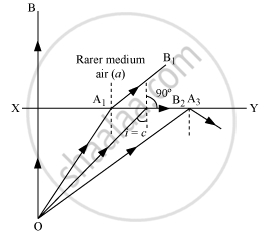
Total internal reflection is the phenomenon of reflection of light into a denser medium from an interface of the denser medium and the rarer medium. Two essential conditions for total internal reflection: Incident ray should travel in the denser medium and refracted ray should travel in the rarer medium.
The angle of incidence (i) should be greater than the critical angle for the pair of media in contact.
The relation between refractive index and critical angle (C):
When i = C and r = 90°
Apply Snell's law
`mu_b sinC = mu_a sin90^circ = mu_a xx 1`
`mu_b/mu_a = 1/sin C`
`""^amu_b = 1/sin C`.
संबंधित प्रश्न
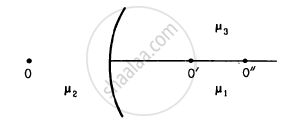
Following figure shows three transparent media of refractive indices \[\mu_1 , \mu_2 \text{ and } \mu_3\]. A point object O is placed in the medium \[\mu_2\]. If the entire medium on the right of the spherical surface has refractive index \[\mu_3\], the image forms at O". In the situation shown,
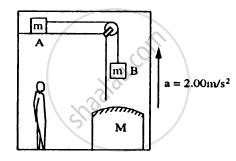
Consider the situation shown in figure. The elevator is going up with an acceleration of 2.00 m s−2 and the focal length of the mirror is 12.0 cm. All the surfaces are smooth and the pulley is light. The mass-pulley system is released from rest (with respect to the elevator) at t = 0 when the distance of B from the mirror is 42.0 cm. Find the distance between the image of the block B and the mirror at t = 0.200 s. Take g = 10 m s−2.
A converging lens of focal length 40 cm is kept in contact with a diverging lens of focal length 30 cm. Find the focal length of the combination .
The direction of ray of light incident on a concave mirror is shown by PQ while directions in which the ray would travel after reflection is shown by four rays marked 1, 2, 3 and 4 (figure). Which of the four rays correctly shows the direction of reflected ray?

An object is 20 cm away from a concave mirror and it is within the focal length of the mirror. If the mirror is changed to a plane mirror, the image moves 15 cm closer to the mirror.
Focal length of the concave mirror is ______.
Parallel rays striking a spherical mirror far from the optic axis are focussed at a different point than are rays near the axis thereby the focus moves toward the mirror as the parallel rays move toward the outer edge of the mirror. What value of incidence angle θ produces a 2% change in the location of the focus, compared to the location for θ very close to zero?
If an object is placed at a distance of 10 cm in front of a concave mirror of a focal length of 20 cm, the image formed will be ______.
Which of the following is a correct statement of one of the laws of reflection?
The angle of incidence is the angle between:
According to the laws of reflection, the incident ray, the reflected ray, and the normal to the reflecting surface at the point of incidence:
