Advertisements
Advertisements
प्रश्न
Define the critical angle for a given pair of media and total internal reflection. Obtain the relation between the critical angle and refractive index of the medium.
Advertisements
उत्तर
The angle of incidence corresponding to an angle of refraction of 90° is called the critical angle for the given pair of media. If the angle of incidence of light, when travelling from a denser medium to a rarer medium, is greater than the critical angle then total internal reflection takes place.

Let the angle of incidence i and C be the critical angle C.
Let the angle of refraction r = 90°.
The refractive index of the rarer medium is μa.
The refractive index of the denser medium is μb.
Applying Snell's law,
`(sini)/(sinr) = mu_a/mu_b`
μb sinC = μa sin90° ....[∵ i = C and r = 90°]
`mu_a/mu_b = 1/(sinC)`
Thus, we arrive at a formula expressing the critical angle and refractive index relation:
`""_amu_b = 1/(sinC)`
APPEARS IN
संबंधित प्रश्न
An extended object is placed at a distance of 5.0 cm from a convex lens of focal length 8.0 cm. (a) Draw the ray diagram (to the scale) to locate the image and from this, measure the distance of the image from the lens. (b) Find the position of the image from the lens formula and see how close the drawing is to the correct result.
A converging lens of focal length 15 cm and a converging mirror of focal length 10 cm are placed 50 cm apart with common principal axis. A point source is placed in between the lens and the mirror at a distance of 40 cm from the lens. Find the locations of the two images formed.
A converging lens of focal length 15 cm and a converging mirror of focal length 10 cm are placed 50 cm apart. If a pin of length 2.0 cm is placed 30 cm from the lens farther away from the mirror, where will the final image form and what will be the size of the final image?
A 5 mm high pin is placed at a distance of 15 cm from a convex lens of focal length 10 cm. A second lens of focal length 5 cm is placed 40 cm from the first lens and 55 cm from the pin. Find (a) the position of the final image, (b) its nature and (c) its size.
Use the above relation to obtain the condition on the position of the object and the radius of curvature in terms of n1and n2 when the real image is formed.
Define the term ‘focal length of a mirror’.
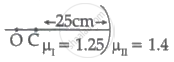
Region I and II are separated by a spherical surface of a radius of 25 cm. An object is kept in the region I at a distance of 40 cm from the surface. The distance of the image from the surface is ______.
A point object in the air is placed symmetrically at a distance of 60 cm in front of a concave spherical surface with a refractive index of 1.5. If the radius of curvature of the surface is 20 cm, find the position of the image formed.
Obtain an expression for refraction at a single convex spherical surface, i.e., the relation between μ1 (rarer medium), μ2 (denser medium), object distance u, image distance v and the radius of curvature R.
Assertion: If critical angle of glass-air pair `("μg" = 3/2)` is θ1 and that of water-air pair `("μw" = 4/3)` is θ2, then the critical angle for the water-glass pair will lie between θ1 and θ2.
Reason: A medium is optically denser if its refractive index is greater.
