Advertisements
Advertisements
Question
Consider the situation described in the previous problem. Where should a point source be placed on the principal axis so that the two images form at the same place?
Advertisements
Solution
Given,
Convex lens of focal length (fl) = 15 cm
Concave mirror of focal length (fm) = 10 cm
Distance between lens and mirror = 50 cm
Thus, two images will be formed,
(a) One due to direct transmission of light through lens.
(b) One due to reflection and then transmission of the rays through lens.
Let the point source be placed at a distance of 'x' from the lens as shown in the Figure, so that images formed by lens and mirror coincide.
For lens,
We use lens formula:
\[\frac{1}{v} - \frac{1}{u} = \frac{1}{15}\]
\[\Rightarrow v=\frac{15x}{x - 15}...( i)\]
For mirror,
Object distance will be (50 − x)
We use the formula:
\[\frac{1}{v} + \frac{1}{u} = \frac{1}{15}\]
u = − (50 − x)
fm = − 10 cm
\[So, \frac{1}{v_m} + \frac{1}{- (50 - x)} = - \frac{1}{10}\]
\[ \Rightarrow \frac{1}{v_m} = \frac{1}{50 - x} - \frac{1}{10}\]
\[ = \frac{10 - 50 + x}{10(50 - x)}\]
\[ v_m =\frac{x - 40}{10(50 - x)} . . . (ii)\]
Since the distance between lens and mirror is 50 cm,
v − vm = 50
from equation (i) and (ii):
\[\Rightarrow \frac{15x}{x - 15} - \frac{10(50 - x)}{(x - 40)} = 50\]
⇒(3x2 − 120x) − (100x − 2x2 − 1500 + 30x)
= 10 (x2 − 55x + 600)
⇒ 5x2 − 250x − 1500 = 10x2 − 550x + 6000
⇒ 5x2 − 300x + 4500 = 0
⇒ x2 − 60x + 900 = 0
⇒ (x − 30)2 = 0
x = 30 cm.
∴ Point source should be placed at a distance of 30 cm from the lens on the principal axis, so that the two images form at the same place.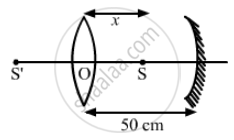
APPEARS IN
RELATED QUESTIONS
Calculate the focal length of a corrective lens having power +2.5 D.
What is meant by a power of a lens? Define its SI unit.
What does sign of power (+ve or –ve) indicate?
Define 1 dioptre of power of a lens.
Name the physical quantity whose unit is dioptre.
A diverging lens has focal length of 3 cm. Calculate the power.
The power of a lens is + 0.2 D. Calculate its focal length.
What is the unit of power of a lens? Define the unit of power of a lens.
A diverging lens has a focal length of 0.10 m. The power of this lens will be:
How is the power of a lens related to its focal length?
How does focal length of a lens change when red light incident on it is replaced by violet light? Give reason for your answer.
Consider three converging lenses L1, L2 and L3 having identical geometrical construction. The index of refraction of L1 and L2 are \[\mu_1 \text{ and } \mu_2\] respectively. The upper half of the lens L3 has a refractive index \[\mu_1\] and the lower half has \[\mu_2\] following figure . A point object O is imaged at O1 by the lens L1 and at O2 by the lens L2placed in same position. If L3 is placed at the same place,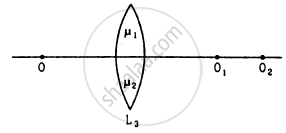
(a) there will be an image at O1
(b) there will be an image at O2.
(c) the only image will form somewhere between O1 and O2
(d) the only image will form away from O2.
A convex lens produces a double size real image when an object is placed at a distance of 18 cm from it. Where should the object be placed to produce a triple size real image?
Surabhi from std. X uses spectacle. The power of the lenses in her spectacle is 0.5 D.
Answer the following questions from the given information:
- Identify the type of lenses used in her spectacle.
- Identify the defect of vision Surabhi is suffering from.
- Find the focal length of the lenses used in her spectacle.
The power of a lens is +2.0 D. Find its focal length and state the kind of lens.
If there is a convex lens of focal length 75 cm and a concave lens of focal length 40 cm, then calculate their combined power and combined focal length.
Power of a lens is – 4D, then its focal length is
Increase in the converging power of eye lens cause ‘hypermetropia'
An object is kept at a distance of 1m from a lens of power +2D:
- Identify the type of lens.
- Calculate its focal length and distance of the image formed.
A lens has a power of \[+2\,D\]. Its focal length is:
