Advertisements
Advertisements
प्रश्न
A 5.0 diopter lens forms a virtual image which is 4 times the object placed perpendicularly on the principal axis of the lens. Find the distance of the object from the lens.
Advertisements
उत्तर
Given,
Power of the lens (P) = \[\frac{1}{\text{ Focal length}}\] = 5.0 D
The height of the image is four times the height of the object.
i.e. \[h_i = 4 h_0 , \frac{h_i}{h_0} = 4\]
We know magnification (m) is also given by \[m = \frac{h_i}{h_0} = \frac{v}{u} \Rightarrow \frac{v}{u} = 4, v = 4u\]
The lens maker formula is given by \[\frac{1}{v} - \frac{1}{u} = \frac{1}{f}\]
Here, v is the image distance and u is the object distance.
Now,
\[\frac{1}{f} = P = 5 \text{ and } f = \frac{1}{5} m = 20 \text{ cm }\]
\[\frac{1}{4u} - \frac{1}{u} = \frac{1}{20}\]
\[ - \frac{3}{4u} = \frac{1}{20}\]
\[ \Rightarrow u = - \frac{60}{4} = - 15 \text{ cm }\]
Hence, the required object distance is 15 cm.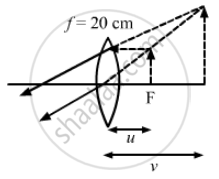
APPEARS IN
संबंधित प्रश्न
A convex lens forms a real and inverted image of a needle at a distance of 50 cm from it. Where is the needle placed in front of the convex lens if the image is equal to the size of the object? Also, find the power of the lens.
(a) At what distance should the lens be held from the figure in order to view the squares distinctly with the maximum possible magnifying power?
(b) What is the magnification in this case?
(c) Is the magnification equal to the magnifying power in this case? Explain.
A student uses a lens of focal length 40 cm and another of –20 cm. Write the nature and power of each lens
Which one of the following materials cannot be used to make a lens?
What is the unit of power of a lens? Define the unit of power of a lens.
A stick partly immersed in water appears to be bent. Draw a ray diagram to show the bending of the stick when placed in water and viewed obliquely from above.
Power of a lens is – 4D, then its focal length is
According to Rayleigh’s scattering law, the amount of scattering of light is inversely proportional to the fourth power of its ______.
Assertion and reasoning type
- Assertion: Myopia is due to the increase in the converging power of eye lens.
- Reason: Myopia can be corrected with the help of concave lens.
Define power of a lens. What is its unit? One student uses a lens of focal length 50 cm and another of –50 cm. What is the nature of the lens and its power used by each of them?
The focal length of a concave lens is 20 cm. The focal length of a convex lens is 25 cm. These two are placed in contact with each other. What is the power of the combination? Is it diverging, converging or undeviating in nature?
A point object is placed at O in front of a glass sphere as shown in figure.

Show the formation of the image by the sphere.
When monochromatic red light is used instead of blue light in a convex lens, its focal length will ______.
In what unit is the power of a lens expressed?
The deviation of the incident light rays produced by a lens on refraction through it is a measure of its:
1 D is equivalent to:
A lens has a power of \[+2\,D\]. Its focal length is:
