Advertisements
Advertisements
Question
A 5.0 diopter lens forms a virtual image which is 4 times the object placed perpendicularly on the principal axis of the lens. Find the distance of the object from the lens.
Advertisements
Solution
Given,
Power of the lens (P) = \[\frac{1}{\text{ Focal length}}\] = 5.0 D
The height of the image is four times the height of the object.
i.e. \[h_i = 4 h_0 , \frac{h_i}{h_0} = 4\]
We know magnification (m) is also given by \[m = \frac{h_i}{h_0} = \frac{v}{u} \Rightarrow \frac{v}{u} = 4, v = 4u\]
The lens maker formula is given by \[\frac{1}{v} - \frac{1}{u} = \frac{1}{f}\]
Here, v is the image distance and u is the object distance.
Now,
\[\frac{1}{f} = P = 5 \text{ and } f = \frac{1}{5} m = 20 \text{ cm }\]
\[\frac{1}{4u} - \frac{1}{u} = \frac{1}{20}\]
\[ - \frac{3}{4u} = \frac{1}{20}\]
\[ \Rightarrow u = - \frac{60}{4} = - 15 \text{ cm }\]
Hence, the required object distance is 15 cm.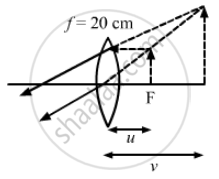
APPEARS IN
RELATED QUESTIONS
What is meant by a power of a lens? Define its SI unit.
What is the focal length of a convex lens of focal length 30 cm in contact with a concave lens of focal length 20 cm? Is the system a converging or a diverging lens? Ignore thickness of the lenses.
(a) At what distance should the lens be held from the figure in order to view the squares distinctly with the maximum possible magnifying power?
(b) What is the magnification in this case?
(c) Is the magnification equal to the magnifying power in this case? Explain.
You have two lenses A and B of focal lengths +10 cm and –10 cm, respectively. State the nature and power of each lens. Which of the two lenses will form a virtual and magnified image of an object placed 8 cm from the lens? Draw a ray diagram to justify your answer
Which one of the following materials cannot be used to make a lens?
Which has more power : a thick convex lens or a thin convex lens, made of the same glass? Give reason for your choice.
An object of height 4 cm is placed at a distance of 15 cm in front of a concave lens of power, −10 dioptres. Find the size of the image.
A combination of lenses for a camera contains two converging lenses of focal lengths 20 cm and 40 cm and a diverging lens of focal length 50 cm. Find the power and focal length of the combination.
A converging lens has a focal length of 50 cm. The power of this lens is:
State the condition for the following a ray passes undeviated through the lens .
A double convex lens has two surfaces of equal radii R and refractive index \[m = 1 \cdot 5\]
A symmetric double convex lens in cut in two equal parts by a plane perpendicular to the principal axis. If the power of the original lens was 4 D, the power a cut-lens will be
A double convex lens has focal length 25 cm. The radius of curvature of one of the surfaces is double of the other. Find the radii, if the refractive index of the material of the lens is 1.5.
Find the power of a convex lens of focal length of + 25 cm.
The focal length of a double convex lens is equal to the radius of curvature of either surface. What is the refractive index of its material?
The deviation of the incident light rays produced by a lens on refraction through it is a measure of its:
The SI unit of the power of a lens is the:
A greater numerical value of the power of a lens means:
If the refractive index of the lens material is less than that of the surrounding liquid (\[n_2 < n_1\]), then:
The power of a lens of focal length \[f = 0.5\,m\] is:
