Advertisements
Advertisements
Question
An object of height 4 cm is placed at a distance of 15 cm in front of a concave lens of power, −10 dioptres. Find the size of the image.
Advertisements
Solution
Object distance u = -15 cm
Height of object h = 4 cm
Power of the lens p = -10 dioptres
Height of image h' = ?
Image distance v = ?
Focal length of the lens f = ?
We know that:
`p=1/f`
`f=1/p`
⇒`f=1/-10`
⇒ `f=-0.1m =-10 cm`
From the lens formula, we have:
`1/v-1/u=1/f`
`1/v-1/-15=1/-10`
⇒`1/v+1/15=-1/10`
⇒`1/v=-1/15-1/10`
⇒`1/v=(-2-3)/30`
⇒`1/v=-5/30`
⇒`1/v=-1/6`
⇒`v=-6` cm
Thus, the image will be formed at a distance of 6 cm and in front of the mirror.
Now, magnification m =`v/u=(h')/h`
or `(-6)/(-15)=(h')/4`
`h'=(6x4)/15`
`h'=24/15`
∴`h'=1.6 cm`
RELATED QUESTIONS
What is meant by a power of a lens? Define its SI unit.
Define the power of a lens.
State the power of a lens S.I. unit.
The lens mentioned in 6(b) above is of focal length 25cm. Calculate the power of the lens.
Consider two statements A and B given below:
A: real image is always inverted
B: virtual image is always erect
Out of these two statements:
How is the power of a lens related to its focal length?
A converging lens has focal length of 50 mm. What is the power of the lens?
The power of a lens is, −2 D. What is its focal length?
A doctor has prescribed a corrective lens of power, −1.5 D. Find the focal length of the lens. Is the prescribed lens diverging or converging?
What is the unit of power of a lens? Define the unit of power of a lens.
Define power of a lens. Write its units. Deduce the relation `1/f =1/f_1 +1/f_2`for two thin lenses kept in contact coaxially.
Mohan obtained a sharp inverted image of a distant tree on the screen placed behind the lens. He then moved the screen and tried to look through the lens in the direction of the object. He would see:
(1) a blurred image on the wall of the laboratory.
(2) an erect image of the tree on the lens.
(3) no image as the screen has been removed
(4) an inverted image of the tree at the focus of the lens.
A thin converging lens is formed with one surface convex and the other plane. Does the position of image depend on whether the convex surface or the plane surface faces the object?
A symmetric double convex lens in cut in two equal parts by a plane perpendicular to the principal axis. If the power of the original lens was 4 D, the power a cut-lens will be
The power of a lens is +2.0 D. Find its focal length and state the kind of lens.
If there is a convex lens of focal length 75 cm and a concave lens of focal length 40 cm, then calculate their combined power and combined focal length.
Find the power of a convex lens of focal length of + 25 cm.
If focal length of a convex lens is 20 cm at what is the power of the lens?
Assertion and reasoning type
- Assertion: Myopia is due to the increase in the converging power of eye lens.
- Reason: Myopia can be corrected with the help of concave lens.
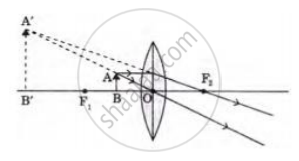
The above lens has a focal length of 10 cm. The object of height 2 mm is placed at a distance of 5 cm from the pole. Find the height of the image.
A convex lens with radii of curvature R1 = R2 is immersed in water. Assuming that the refractive indices of glass and water are 3/2 and 4/3 respectively, its focal length f1 in comparison to that in air, f, is ______.
In what unit is the power of a lens expressed?
One dioptre is the power of a lens whose focal length is:
The power of a lens in dioptres is given by:
The power of a lens placed in a medium is given by:
A convex lens is a converging lens whose focal length and power are both:
A negative power of a lens indicates a:
When a lens is placed in a liquid, the total power of the lens is:
A convex lens has:
