Advertisements
Advertisements
प्रश्न
An object of height 4 cm is placed at a distance of 15 cm in front of a concave lens of power, −10 dioptres. Find the size of the image.
Advertisements
उत्तर
Object distance u = -15 cm
Height of object h = 4 cm
Power of the lens p = -10 dioptres
Height of image h' = ?
Image distance v = ?
Focal length of the lens f = ?
We know that:
`p=1/f`
`f=1/p`
⇒`f=1/-10`
⇒ `f=-0.1m =-10 cm`
From the lens formula, we have:
`1/v-1/u=1/f`
`1/v-1/-15=1/-10`
⇒`1/v+1/15=-1/10`
⇒`1/v=-1/15-1/10`
⇒`1/v=(-2-3)/30`
⇒`1/v=-5/30`
⇒`1/v=-1/6`
⇒`v=-6` cm
Thus, the image will be formed at a distance of 6 cm and in front of the mirror.
Now, magnification m =`v/u=(h')/h`
or `(-6)/(-15)=(h')/4`
`h'=(6x4)/15`
`h'=24/15`
∴`h'=1.6 cm`
संबंधित प्रश्न
What is meant by a power of a lens? Define its SI unit.
Find the power of a concave lens of focal length 2m.
Find the focal length of a lens of power −2.0 D. What type of lens is this?
A doctor has prescribed a corrective lens of power +1.5 D. Find the focal length of the lens. Is the prescribed lens diverging or converging?
What can you see in a completely dark room? If you switch on an electric bulb in this dark room as a light source, explain how you could now see:
(a) the electric bulb
(b) a piece of white paper
What is the nature of a lens whose power is, −4 D?
A lens has a focal length of, −10 cm. What is the power of the lens and what is its nature?
Fill in the following blank with suitable words :
The reciprocal of the focal length in metres gives you the _________ of the lens, which is measured in ___________.
Define the term focal length of a lens.
How is the power of a lens related to its focal length?
Mohan obtained a sharp inverted image of a distant tree on the screen placed behind the lens. He then moved the screen and tried to look through the lens in the direction of the object. He would see:
(1) a blurred image on the wall of the laboratory.
(2) an erect image of the tree on the lens.
(3) no image as the screen has been removed
(4) an inverted image of the tree at the focus of the lens.
Consider three converging lenses L1, L2 and L3 having identical geometrical construction. The index of refraction of L1 and L2 are \[\mu_1 \text{ and } \mu_2\] respectively. The upper half of the lens L3 has a refractive index \[\mu_1\] and the lower half has \[\mu_2\] following figure . A point object O is imaged at O1 by the lens L1 and at O2 by the lens L2placed in same position. If L3 is placed at the same place,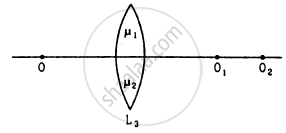
(a) there will be an image at O1
(b) there will be an image at O2.
(c) the only image will form somewhere between O1 and O2
(d) the only image will form away from O2.
A convex lens produces a double size real image when an object is placed at a distance of 18 cm from it. Where should the object be placed to produce a triple size real image?
Surabhi from std. X uses spectacle. The power of the lenses in her spectacle is 0.5 D.
Answer the following questions from the given information:
- Identify the type of lenses used in her spectacle.
- Identify the defect of vision Surabhi is suffering from.
- Find the focal length of the lenses used in her spectacle.
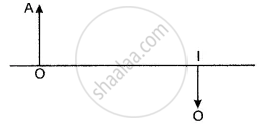
The following diagram shows the object O and the image I formed by a lens. Copy the diagram and on it mark the positions of the lens LL’ and focus (F). Name the lens.
Power of a lens is – 4D, then its focal length is
According to Rayleigh’s scattering law, the amount of scattering of light is inversely proportional to the fourth power of its ______.
Assertion and reasoning type
- Assertion: Myopia is due to the increase in the converging power of eye lens.
- Reason: Myopia can be corrected with the help of concave lens.
The focal length of a concave lens is 20 cm. The focal length of a convex lens is 25 cm. These two are placed in contact with each other. What is the power of the combination? Is it diverging, converging or undeviating in nature?
An object is placed in front of a converging lens. Obtain the conditions under which the magnification produced by the lens is
- negative and
- positive.
The focal length of a double convex lens is equal to the radius of curvature of either surface. What is the refractive index of its material?
The lens of power + 1·0 D is ______.
The SI unit of the power of a lens is the:
1 D is equivalent to:
A concave lens is a diverging lens whose focal length and power are both:
A positive power of a lens indicates a:
For a lens with \[f = +12\,cm\], \[R_1 = +10\,cm\] and \[R_2 = -15\,cm\], the lens maker's formula \[\frac{1}{f}=(n-1)\left(\frac{1}{R_1}-\frac{1}{R_2}\right)\] gives the refractive index of the glass as:
