Advertisements
Advertisements
प्रश्न
The focal length of a convex lens is 25 cm. What is its power?
Advertisements
उत्तर
Given, f = 25 cm
Power of a lens is given by:
Power (p)=1/f
`p=1/(25xx10^-2)=100/25=4.D`
APPEARS IN
संबंधित प्रश्न
Define 1 dioptre of power of a lens.
Find the power of a concave lens of focal length 2m.
A doctor has prescribed a corrective lens of power +1.5 D. Find the focal length of the lens. Is the prescribed lens diverging or converging?
Ranbir claims to have obtained an image twice the size of the object with a concave lens. Is he correct? Give a reason for your answer.
What can you see in a completely dark room? If you switch on an electric bulb in this dark room as a light source, explain how you could now see:
(a) the electric bulb
(b) a piece of white paper
Which one of the following materials cannot be used to make a lens?
What is the power of a convex lens lens whose focal length is 80 cm?
What is the nature of a lens whose power is, −4 D?
Fill in the following blank with suitable words :
The reciprocal of the focal length in metres gives you the _________ of the lens, which is measured in ___________.
A convex lens of power 5 D and a concave lens of power 7.5 D are placed in contact with each other. What is the :
(a) power of this combination of lenses?
(b) focal length of this combination of lenses?
Two lenses A and B have focal lengths of +20 cm and, −10 cm, respectively.
(a) What is the nature of lens A and lens B?
(b) What is the power of lens A and lens B?
(c) What is the power of combination if lenses A and B are held close together?
The power of a lens is +2.0D. Its focal length should be :
A 5.0 diopter lens forms a virtual image which is 4 times the object placed perpendicularly on the principal axis of the lens. Find the distance of the object from the lens.
Complete the diagram to show the formation of the image of the object AB.
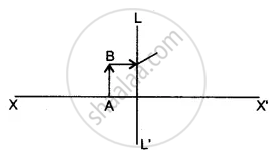
(i) Name the Lens LL’.
(ii) Where is the image of the object AB formed?
(iii) State three characteristics of the image.
A convex lens is of focal length 20 cm. Find its power.
Assertion and reasoning type
- Assertion: Myopia is due to the increase in the converging power of eye lens.
- Reason: Myopia can be corrected with the help of concave lens.
The power of convex lens of focal length 20 cm is ______.
The power of a lens is defined as the:
The SI unit of the power of a lens is the:
