Advertisements
Advertisements
Question
The lens A has a focal length of 25 cm whereas another lens B has a focal length of 60 cm. Giving reason state, which lens has more power: A or B.
Advertisements
Solution
Power varies inversely with the focal length. Lens A has a small focal length and hence, more power.
APPEARS IN
RELATED QUESTIONS
Define the power of a lens.
Find the power of a concave lens of focal length 2m.
The power of a lens is, −2 D. What is its focal length?
What is the nature of a lens whose power is, −4 D?
A lens has a focal length of, −10 cm. What is the power of the lens and what is its nature?
A diverging lens has a focal length of 0.10 m. The power of this lens will be:
The power of a lens is + 1.0 D is :
Name the type of lens whose power is positive.
The image of an object formed by a lens is real, inverted and of the same size as the object. If the image is at a distance of 40 cm from the lens, what is the nature and power of the lens ? Draw ray diagram to justify your answer.
Consider the situation described in the previous problem. Where should a point source be placed on the principal axis so that the two images form at the same place?
Complete the diagram to show the formation of the image of the object AB.
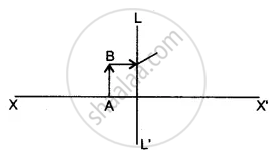
(i) Name the Lens LL’.
(ii) Where is the image of the object AB formed?
(iii) State three characteristics of the image.
If there is a convex lens of focal length 75 cm and a concave lens of focal length 40 cm, then calculate their combined power and combined focal length.
Focal length : metre : : power of lens : _______
Assertion and reasoning type
- Assertion: Myopia is due to the increase in the converging power of eye lens.
- Reason: Myopia can be corrected with the help of concave lens.
Define power of a lens. What is its unit? One student uses a lens of focal length 50 cm and another of –50 cm. What is the nature of the lens and its power used by each of them?
A convex lens with radii of curvature R1 = R2 is immersed in water. Assuming that the refractive indices of glass and water are 3/2 and 4/3 respectively, its focal length f1 in comparison to that in air, f, is ______.
When monochromatic red light is used instead of blue light in a convex lens, its focal length will ______.
The power of a lens is defined as the:
When a lens is placed in a liquid, the total power of the lens is:
The power of a lens of focal length \[f = 0.5\,m\] is:
