Advertisements
Advertisements
प्रश्न
The atomic masses of three elements A, B and C having similar chemical properties are 7, 23 and 39, respectively.
- Calculate the average atomic mass of elements A and C.
- Compare the average atomic mass with atomic mass of B.
- What could the elements A, B and C be?
Advertisements
उत्तर
(a) The average atomic mass of elements A and C = `(7+39)/2=46/2=23`
(b) The average atomic mass of elements A and C is equal to the atomic mass of element B.
(c) A is lithium, B is sodium and C is potassium.
APPEARS IN
संबंधित प्रश्न
The atomic numbers of three elements A, B and C are 12, 18 and 20 respectively. State, giving reason, which two elements will show similar properties.
An element 'X' has mass number 35 and number of neutrons 18. Write atomic number and electronic configuration of 'X'. Also write group number, period number and valency of 'X'.
Based on the group valency of elements state the formula lot the following giving justification for each :-
(i) Oxides of 1st group elements,
(ii) Halides of the elements of group 13, and
(iii) Compounds formed when an element of group 2 combines with, an element of group 16.
Write the number of horizontal rows in the modern periodic table. What are these rows called?
Which element has a total of two shells, with three electrons in its valence shell?
An element with the atomic number 19 will most likely combine chemically with the element whose atomic number is ______.
Use the letters only written in the Periodic Table given below to answer the questions that Follow:
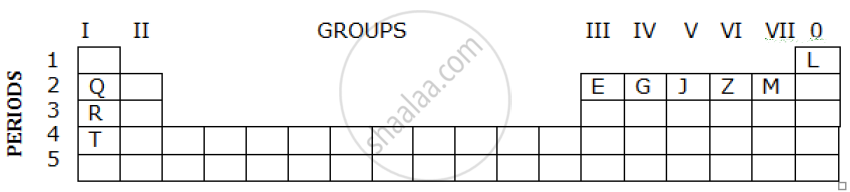
- State the number of valence electrons in atom J.
- Which element shown forms ions with a single negative charge?
- Which metallic element is more reactive than R?
- Which element has its electrons arranged in four shells?
Differentiate between Normal elements and Transition elements.
What happens to the metallic character of the elements as we go down in a group of the periodic table?
Fill in the blank in the following statement:
On going down in a group in the periodic table, the metallic character of elements ...............
Fill in the blank in the following statement:
The tendency to gain an electron ............... on moving down in a group of the periodic table.
How do atomic structures (electron arrangements) change in a period with increase in atomic numbers from left to right?
How does the size of atoms (atomic size) generally vary in going from left to right in a period of the periodic table? Why does it vary this way?
The electronic configuration of the atom of an element X is 2, 8, 4. In modern periodic table, the element X is places in :
(a) 2nd group
(b) 4th group
(c) 14th group
(d) 8th group
Which of the following element does not lose an electron easily?
(a) Na
(b) F
(c) Mg
(d) Al
Where would you locate the element with electronic configuration 2, 8 in the modern periodic table?
The element which has the maximum number of valence electrons is:
(a) Na
(b) P
(c) Si
(d) A
Periodicity is observed due to the similar ______.
Correct the statements.
Elements in the same periods have equal valency.
What do you understand by orbits?
Name two elements you would expect to show chemical reactions similar to calcium. What is the basis of your choice?
An element X belong to 3rd periods and group II of the periodic table state:
the number of valence electrons,
name the elements in period 1.
State whether the following statement is true or false
On moving horizontally across a period, number of valence electrons increases from one to eight.
The elements of one short period of the periodic table are given below in order from left to right:
Li Be B C O F Ne
(a) To which period do these elements belong?
(b) One element of this period is missing. Which is the missing element and where should it be placed?
(c) Place the three elements, fluorine, beryllium and nitrogen, in the order of increasing electro negativity.
(d) Which one of the above elements belongs to the halogen series?
Give the number of the group and the period of elements having three shells with three electrons in valence shell.
Use the letters only written in the Periodic Table given below to answer the questions that follow: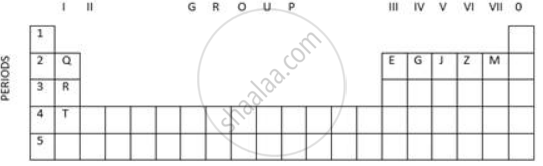
(a) State the number of valence electrons in the atom J.(b) Which element shown forms ions with a single negative charge?
(c) Which Metallic element is more reactive than R?
(d) Which element has its electrons arranged in four shells?
Arrange the following in order of increasing radii:
Mg2+, Mg, Mg+
The elements of one short period of the periodic table are given below in order from left to right:
| Li | Be | B | C | O | F | Ne |
Place the three elements fluorine, beryllium and nitrogen in the order of increasing electronegativity.
The position of elements A, B, C, D and E in the periodic table are shown below:
|
Group 1 |
Group 2 |
Group 17 |
Group 18 |
|
|
|
|
D |
|
|
B |
C |
|
|
A |
|
|
E |
State which is metals, non-metals, and noble gas in this table.
An element belongs to the third period and Group IIIA (13) of the periodic table. State: the number of valence electrons,
State the property trends in general of elements on moving down in a group of the periodic table.
Name or state following with reference to the element of the first three periods of the periodic table.
A non-metal in period 2 which is tetravalent.
Select the correct answer from the options given below.
Is the group number of the element whose atomic number is 4.
Fill in the blanks from the words A to F given below.
A: Decreases
B: Increases
C: Remains same
D: Increases by one
E: Electropositive
F: Electronegative
Down a group in the Modern Periodic Table.
No. of electron shells __________; No. of valence electrons ________; Electronegativity ________ Character of elements changes from _________ to ____________.
