Advertisements
Advertisements
प्रश्न
The atomic masses of three elements A, B and C having similar chemical properties are 7, 23 and 39, respectively.
- Calculate the average atomic mass of elements A and C.
- Compare the average atomic mass with atomic mass of B.
- What could the elements A, B and C be?
Advertisements
उत्तर
(a) The average atomic mass of elements A and C = `(7+39)/2=46/2=23`
(b) The average atomic mass of elements A and C is equal to the atomic mass of element B.
(c) A is lithium, B is sodium and C is potassium.
APPEARS IN
संबंधित प्रश्न
Two elements ‘P’ and ‘Q’ belong to the same period of the modern periodic table and are in Group 1 and Group 2, respectively. Compare their following characteristics in tabular form:-
(a) The number of electrons in their atoms
(b) The sizes of their atoms
(c) Their metallic character
(d) Their tendencies to lose electrons
(e) The formula of their oxides
(f) The formula of their chlorides
Match the atomic number 2, 4, 8, 15 and 19 with each of the following:
- A solid non-metal belonging to the third period.
- A metal of valency 1.
- A gaseous element with valency 2.
- An element belonging to Group 2.
- A rare gas.
Rewrite the following statement after correction, if necessary:
The metallic character of elements in a period increases gradually on moving from left to right.
The atomic radii of three elements X, Y and Z of a period of the periodic table are 186 pm; 104 pm and 143 pm respectively. Giving a reason, arrange these elements in the increasing order of atomic numbers in the period.
In which part of a group would you separately expect the elements to have the greatest metallic character
The electronic configuration of the atom of an element X is 2, 8, 4. In modern periodic table, the element X is places in :
(a) 2nd group
(b) 4th group
(c) 14th group
(d) 8th group
An element which is an essential constituent of all organic compounds belongs to following group of modern periodic table:
(a) group 4
(b) group 14
(c) group 15
(d) group 16
An element X belong to 4th period and 17th group, state.
name the family to which it belong.
An element X belong to 3rd periods and group II of the periodic table state:
the valency,
What is the common feature of the electronic configuration of the elements at the end of period 2, and period 3?
First ionization enthalpy of two elements X and Y are 500 KJ mol-1 and 375 KJ mol-1 respectively. Comment about their relative position in a group as well as in a period.
How do you calculate the possible valency of an element from the electronic configuration of its atoms?
Arrange the following according to the instruction given in the bracket:
K, Pb, Ca, Zn (in the increasing order of the reactivity).
Study the extract of the Periodic Table given below and answer the questions that follow. Give the alphabet corresponding to the element in question. DO NOT repeat an element. 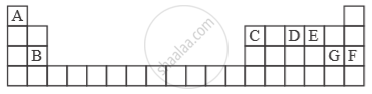
Which is an inert gas?
How many groups and periods are there in the modern periodic table?
Fill in the blank
Most electropositive elements belong to ______ group.
Fill in the blank
Oxidising property ________from fluroine to iodine because the power to accpet electron decreases.
State whether the following statement is true or false
Similar electronic configuration is repeated after intervals of 2, 8, 8, 18 and 32.
State whether the following statement is true or false
On moving horizontally across a period, number of valence electrons increases from one to eight.
Choose the correct answer from the choice given:
An element A belonging to Period 3 and Group II will have
Choose the most appropriate answer from the following list of oxides which fit the description.
An oxide which dissolves in water forming an acid.
Arrange the following as per the instruction given in the bracket
He,Ar,Ne (Increasing order of the number of electron shells)
Arrange the following in order of increasing radii:
Mg2+, Mg, Mg+
Choose the word or phrase from the bracket which correctly complete each of the following statement:
Metals are good ................. (oxidising agents/reducing agents) because they are electron ............. (acceptors/donors).
The position of elements A, B, C, D and E in the periodic table are shown below:
|
Group 1 |
Group 2 |
Group 17 |
Group 18 |
|
|
|
|
D |
|
|
B |
C |
|
|
A |
|
|
E |
State which is most reactive (i) metal (ii) non-metal
The position of elements A, B, C, D and E in the periodic table are shown below:
|
Group 1 |
Group 2 |
Group 17 |
Group 18 |
|
|
|
|
D |
|
|
B |
C |
|
|
A |
|
|
E |
Which is larger in size (i) D or E (ii) B or C
Name and state the following with reference to the elements of the first three periods of the periodic table.
Metalloid in Period 3.
State the nature of compounds formed when group 17 elements combine with (i) metals (ii) non-metals.
An element A has 2 electrons in its fourth shell. State:
is it a metal or non-metal
(a) Fill in the blanks and rewrite the completed statements:
(i) ________ group in the periodic table contains elements that are all gases at room temperature.
(ii) Very fine particles mainly scatter ______ light.
The electronic configuration of an element is 2, 8, 4. State it:
group and period in the Modern Periodic Table.
The position of certain elements in the Modern Periodic Table is shown below:
| Group → Period ↓ |
1 | 2 | 3 to 12 | 13 | 14 | 15 | 16 | 17 | 18 |
| 1 | G | H | |||||||
| 2 | A | I | B | C | |||||
| 3 | D | E | F |
Using the above table answer the following questions giving reasons in each case:
- Which element will form only covalent compounds?
- Which element is a non-metal with valency 2?
- Which element is a metal with valency 2?
- Out of H, C, and F which has the largest atomic size?
- To which family does H, C, and F belong?
Name the elements in Period 1.
The similarities in the properties of a group of elements are because they have the same ______.
Name or state following with reference to the element of the first three periods of the periodic table.
The valency of elements in group 1 [I–A].
Fill in the blanks from the words A to F given below.
A: Decreases
B: Increases
C: Remains same
D: Increases by one
E: Electropositive
F: Electronegative
Down a group in the Modern Periodic Table.
No. of electron shells __________; No. of valence electrons ________; Electronegativity ________ Character of elements changes from _________ to ____________.
State the following:
The group which contains highly electropositive metals including sodium.
