The Equation of Refraction at a Spherical Surface is μ 2 ν − μ 1 μ = μ 2 − μ 1 R
Advertisements
प्रश्न
The equation of refraction at a spherical surface is \[\frac{\mu_2}{\nu} - \frac{\mu_1}{\mu} = \frac{\mu_2 - \mu_1}{R}\]
Taking \[R = \infty\] show that this equation leads to the equation
\[\frac{\text{ Real depth }}{\text{ Apparent depth }} = \frac{\mu_2}{\mu_1}\]
for refraction at a plane surface.
Advertisements
उत्तर
Proof:
\[\frac{\mu_2}{v} - \frac{\mu_1}{u} = \frac{\mu_2 - \mu_1}{R}\]
\[Now R = \infty \]
\[ \frac{\mu_2}{v} - \frac{\mu_1}{u} = \frac{\mu_2 - \mu_1}{\infty}\]
\[\frac{\mu_2}{v} - \frac{\mu_1}{u} = 0\]
\[ \frac{\mu_2}{v} = \frac{\mu_1}{u}\]
\[\frac{\mu_1}{\mu_2} = \frac{u}{v}\]
\[But \frac{u}{v} = \frac{\text{ Real depth/height}}{\text{ Apparent depth/height}} \]
\[ \therefore \frac{\text{ Real depth }/height}{\text{ Apparent depth/height }} = \frac{\mu_1}{\mu_2}\]
APPEARS IN
संबंधित प्रश्न
A point source of light is placed at a distance of 2 f from a converging lens of focal length f. The intensity on the other side of the lens is maximum at a distance
An extended object is placed at a distance of 5.0 cm from a convex lens of focal length 8.0 cm. (a) Draw the ray diagram (to the scale) to locate the image and from this, measure the distance of the image from the lens. (b) Find the position of the image from the lens formula and see how close the drawing is to the correct result.
A point object is placed at a distance of 15 cm from a convex lens. The image is formed on the other side at a distance of 30 cm from the lens. When a concave lens is placed in contact with the convex lens, the image shifts away further by 30 cm. Calculate the focal lengths of the two lenses.
Two convex lenses, each of focal length 10 cm, are placed at a separation of 15 cm with their principal axes coinciding. (a) Show that a light beam coming parallel to the principal axis diverges as it comes out of the lens system. (b) Find the location of the virtual image formed by the lens system of an object placed far away. (c) Find the focal length of the equivalent lens. (Note that the sign of the focal length is positive although the lens system actually diverges a parallel beam incident on it.)
According to new Cartesian sign conventions, all the distances are measured from the ______.
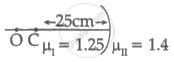
Region I and II are separated by a spherical surface of a radius of 25 cm. An object is kept in the region I at a distance of 40 cm from the surface. The distance of the image from the surface is ______.
Define the critical angle for a given pair of media and total internal reflection. Obtain the relation between the critical angle and refractive index of the medium.
A point object in the air is placed symmetrically at a distance of 60 cm in front of a concave spherical surface with a refractive index of 1.5. If the radius of curvature of the surface is 20 cm, find the position of the image formed.
Which of the following correctly states the relation for refraction at a spherical surface?
In the Cartesian sign convention, distances measured in the direction of incident light are taken as:
For a real object placed to the left of a spherical refracting surface, the object distance u is:
Which ray is considered in the first step of the derivation for refraction at a spherical surface?
Which set of variables is primarily involved in refraction at a spherical surface, as opposed to refraction at a plane surface?
An object is placed at a distance of 100 cm in air from a convex spherical surface of glass of refractive index 1.5. The radius of curvature is 20 cm. What is the image distance?
In the geometrical setup for refraction at a spherical surface, the centre of curvature, object distance, image distance, and radius of curvature are denoted respectively by:
When a light ray strikes a curved surface and refracts, the amount of bending depends on:
