Advertisements
Advertisements
प्रश्न
Which one of the following materials cannot be used to make a lens?
पर्याय
Water
Glass
Plastic
Clay
Advertisements
उत्तर
Clay
Explanation:
since it is opaque and does not let light pass through it.
APPEARS IN
संबंधित प्रश्न
Kavita from 10th is using spectacles. The power of the lenses in her spectacles is –2.5 dioptre. Answer the following questions:
1) Which lenses are used in her spectacles?
2) State the defect of vision Kavita is suffering from.
3) Find the focal length of the lenses used in her spectacles
Consider two statements A and B given below:
A: real image is always inverted
B: virtual image is always erect
Out of these two statements:
How is the power of a lens related to its focal length?
A diverging lens has focal length of 3 cm. Calculate the power.
The power of a lens is + 0.2 D. Calculate its focal length.
The optician's prescription for a spectacle lens is marked +0.5 D. What is the:
(a) nature of spectacle lens?
(b) focal length of spectacle lens?
Fill in the following blank with suitable words :
The reciprocal of the focal length in metres gives you the _________ of the lens, which is measured in ___________.
A convex lens of power 5 D and a concave lens of power 7.5 D are placed in contact with each other. What is the :
(a) power of this combination of lenses?
(b) focal length of this combination of lenses?
The power of a combination of two lenses X and Y is 5 D. If the focal length of lens X be 15 cm :
(a) calculate the focal length of lens Y.
(b) state the nature of lens Y.
Define the term focal length of a lens.
State the condition for the following a lens has both its focal lengths equal .
How does the power of a lens change if its focal length is doubled?
How is the sign (+ or -) of power of a lens related to its divergent or convergent action?
On reducing the focal length of a lens, its power ______.
Find the radius of curvature of the convex surface of a plano-convex lens, whose focal length is 0.3 m and the refractive index of the material of the lens is 1.5.
A thin converging lens is formed with one surface convex and the other plane. Does the position of image depend on whether the convex surface or the plane surface faces the object?
A symmetric double convex lens in cut in two equal parts by a plane perpendicular to the principal axis. If the power of the original lens was 4 D, the power a cut-lens will be
Consider the situation described in the previous problem. Where should a point source be placed on the principal axis so that the two images form at the same place?
The power of a lens is +2.0 D. Find its focal length and state the kind of lens.
A convex lens is of focal length 20 cm. Find its power.
If focal length of a convex lens is 20 cm at what is the power of the lens?
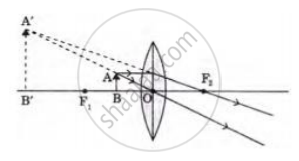
The above lens has a focal length of 10 cm. The object of height 2 mm is placed at a distance of 5 cm from the pole. Find the height of the image.
The focal length of a concave lens is 20 cm. The focal length of a convex lens is 25 cm. These two are placed in contact with each other. What is the power of the combination? Is it diverging, converging or undeviating in nature?
A convex lens with radii of curvature R1 = R2 is immersed in water. Assuming that the refractive indices of glass and water are 3/2 and 4/3 respectively, its focal length f1 in comparison to that in air, f, is ______.
The power of convex lens of focal length 20 cm is ______.
An object is kept at a distance of 1m from a lens of power +2D:
- Identify the type of lens.
- Calculate its focal length and distance of the image formed.
The power of a lens in dioptres is given by:
A concave lens is a diverging lens whose focal length and power are both:
A convex lens has:
