Advertisements
Advertisements
प्रश्न
Define 1 dioptre of power of a lens.
Advertisements
उत्तर १
The SI unit of power of lens is dioptre which is denoted by the letter D. 1 dioptre is defined as the power of a lens of focal length 1 metre.
उत्तर २
1 dioptre is the power of a lens whose focal length is 1 metre.
संबंधित प्रश्न
A convex lens forms a real and inverted image of a needle at a distance of 50 cm from it. Where is the needle placed in front of the convex lens if the image is equal to the size of the object? Also, find the power of the lens.
Find the power of a concave lens of focal length 2m.
Which one of the following materials cannot be used to make a lens?
How is the power of a lens related to its focal length?
Which has more power : a thick convex lens or a thin convex lens, made of the same glass? Give reason for your choice.
A lens has a focal length of, −10 cm. What is the power of the lens and what is its nature?
Fill in the following blank with suitable words :
The reciprocal of the focal length in metres gives you the _________ of the lens, which is measured in ___________.
Fill in the following blank with suitable word:
For converging lenses, the power is __________ while for diverging lenses, the power is ___________.
What do you understand by the power of a lens?
The power of a lens is +2.0D. Its focal length should be :
On reducing the focal length of a lens, its power ______.
A symmetric double convex lens is cut in two equal parts by a plane containing the principal axis. If the power of the original lens was 4 D, the power of a divided lens will be
Consider three converging lenses L1, L2 and L3 having identical geometrical construction. The index of refraction of L1 and L2 are \[\mu_1 \text{ and } \mu_2\] respectively. The upper half of the lens L3 has a refractive index \[\mu_1\] and the lower half has \[\mu_2\] following figure . A point object O is imaged at O1 by the lens L1 and at O2 by the lens L2placed in same position. If L3 is placed at the same place,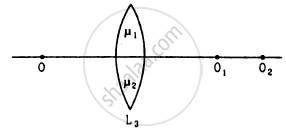
(a) there will be an image at O1
(b) there will be an image at O2.
(c) the only image will form somewhere between O1 and O2
(d) the only image will form away from O2.
A double convex lens has focal length 25 cm. The radius of curvature of one of the surfaces is double of the other. Find the radii, if the refractive index of the material of the lens is 1.5.
Consider the situation described in the previous problem. Where should a point source be placed on the principal axis so that the two images form at the same place?
A stick partly immersed in water appears to be bent. Draw a ray diagram to show the bending of the stick when placed in water and viewed obliquely from above.
Power of a lens is – 4D, then its focal length is
A point object is placed at O in front of a glass sphere as shown in figure.

Show the formation of the image by the sphere.
When monochromatic red light is used instead of blue light in a convex lens, its focal length will ______.
The deviation of the incident light rays produced by a lens on refraction through it is a measure of its:
A concave lens is a diverging lens whose focal length and power are both:
A negative power of a lens indicates a:
If the lens material and the surrounding liquid have the same refractive index (\[n_2 = n_1\]), then:
If the refractive index of the lens material is less than that of the surrounding liquid (\[n_2 < n_1\]), then:
A concave lens has:
For a lens with \[f = +12\,cm\], \[R_1 = +10\,cm\] and \[R_2 = -15\,cm\], the lens maker's formula \[\frac{1}{f}=(n-1)\left(\frac{1}{R_1}-\frac{1}{R_2}\right)\] gives the refractive index of the glass as:
