Advertisements
Advertisements
Question
An object is placed at a distance 20cm from a convex lens of focal length 10cm. Find the image distance and nature of the image.
Advertisements
Solution
u = -20 cm
f = 10 cm
`1/"f"` = `1/"v"`- `1/"u"`
`1/"v"` = `1/"f"`+ `1/"u"`
`1/"v"`= `1/10`+`1/"(-120)"`
`1/"v"`=`1/10`- `1/20`
v = `1/20` ⇒ v = 20 cm
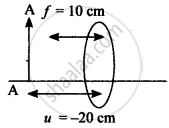
Nature of the image real enlarged and inverted image.
APPEARS IN
RELATED QUESTIONS
A lens forms an upright and diminished image of an object when the object is placed at its focal point. Name the lens and draw a ray diagram to show the image formation.
A converging lens forms the image of an object placed in front of it beyond 2F2 of the lens. Where is the object placed?
A converging lens forms the image of an object placed in front of it, beyond 2F2 of the lens. State three characteristics of the image.
Draw a ray diagram to show how a converging lens can form a real and enlarged image of an object.
A lens forms an inverted image of an object. What is the nature of the image real or virtual?
An object is placed at a distance of more than 40 cm from a convex lens of focal length 20 cm. The image formed is real, inverted and ______.
An object is placed at a distance 5 cm from a convex lens of focal length 10 cm. The image formed is virtual, upright and _____.
Where should an object be placed so that a real and inverted image of the same size is obtained by a convex lens?
Complete the following table based on image formation by convex lens:
| Position of Object | Position of Image | Nature of Image |
| At infinity | (a) ______ | Real and inverted and highly diminished image |
| Beyond 2F1 | (b) ______ | (c) ______ |
| At 2F1 | (d) ______ | Real, inverted, same size (as object) image |
| Between F1 and 2F1 | Beyond 2F2 | (e) ______ |
| At focus F1 | (f) ______ | Real, inverted and highly enlarged image |
A lens forms an upright and magnified image of an object. Draw a labelled ray diagram to show the image formation.
