Advertisements
Advertisements
Question
Name the defect of vision which makes the eye-lens cloudy resulting in blurred vision.
Advertisements
Solution
Cataract is the defect of vision that makes the eye lens cloudy, causing blurred vision.
APPEARS IN
RELATED QUESTIONS
Explain two possible reasons of myopia. How can it be corrected? Explain with a suitable diagram.
the biological/technical terms for the lens of eye losing flexibility resulting in a kind of long-sightedness in middle aged people.
What is the scientific name of
short-sightedness
Name the defect of vision in which the eye-lens loses its power of accommodation due to old age.
Name the body part with which the terms myopia and hypermetropia are connected.
A student sitting in the last row of the class-room is not able to read clearly the writing on the blackboard.
How can this defect by corrected?
Explain with the help of labelled ray-diagram, the defect of vision called hypermetropia, and hot it is corrected by a lens.
What is long-sightedness? State the two causes of long-sightedness (or hypermetropia). With the help of ray diagrams, show:
(i) the eye-defect long-sightedness.
(ii) correction of long-sightedness by using a lens.
The defect of vision in which the eye-lens of a person gets progressively cloudy resulting in blurred vision is called:
(a) myopia
(b) presbyopia
(c) colourblindness
(d) cataract
Name the following:
The photosensitive pigment present in the rods of the retina.
Given below is a diagram depicting a defect of the human eye? Study the same and answer the question that follow :
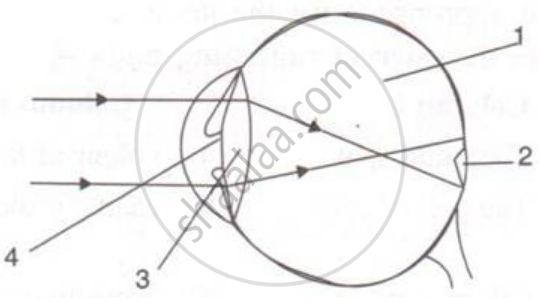
Name the type of lens used to correct this eye defect.
Given below is a diagram depicting a defect of the human eye? Study the same and answer the question that follow:

Draw a labeled diagram to show how the above mentioned defect is rectified using the lens named above.
Give Reason:
When you enter into a dark room from bright because of sunlight, you can not see things for a few seconds.
Draw a neat labeled diagram to show how hypermetropia can be rectified.
Name the following:
The defect of the human eye caused due to the uneven surface of the cornea.
Due to elongation of _______ and increase in curvature of the eye lens, a person cannot see distant objects clearly.
Assertion: Concave mirrors are used as reflectors in torches, vehicle head lights and in search lights.
Reason: When an object is placed beyond the center of curvature of a concave mirror, the image formed is real and inverted.
Which of the following statement is correct?
When do we consider a person to be myopic or hypermetropic? Explain using diagrams how the defects associated with myopic and hypermetropic eye can be corrected?
