Advertisements
Advertisements
Question
Name the body part with which the terms myopia and hypermetropia are connected.
Advertisements
Solution
The eye is the body part with which the terms 'myopia' and 'hypermetropia' are connected.
APPEARS IN
RELATED QUESTIONS
Millions of people in the developing countries of the world are suffering from corneal blindness. These persons can be cured by replacing the defective cornea with the cornea of a donated eye. A charitable society of your city has organised a campaign in your neighbourhood in order to create awareness about this fact. If you are asked to participate in this mission, how would you contribute in this noble cause?
(i) State the objective of organising such campaigns.
(ii) List two arguments which you would give to motivate the people to donate their eyes after death.
(iii) List two values which are developed in the persons who actively participate and contribute in such programmes.
The far point of a myopic person is 80 cm in front of the eye. What is the nature and power of the lens required to correct the problem?
Name the defect of vision in a person:
whose far point is less than infinity
What is the scientific name of
short-sightedness
A man can read the number of a distant bus clearly but he finds difficulty in reading a book.
- From which defect of the eye is he suffering?
- What type of spectacle lens should he use to correct the defect?
A man can read the number of a distant but clearly but he finds difficulty in reading a book.
What type of spectacle lens should he use to correct the defect?
Name the defect of vision which can be corrected by a diverging lens. Show clearly by a ray diagram how the lens corrects the defect.
Though a woman can see the distant object clearly, she cannot see the nearby objects clearly. She is suffering from the defect of vision called:
(a) long-sight
(b) short-sight
(c) hind-sight
(d) mid-sight
Name the following:
The photosensitive pigment present in the rods of the retina.
Describe the mechanism of focusing the image of a distant object in your eye when you raise your head after reading a book.
An old man cannot see objects closer than 1 m from the eye clearly. Name the defect of vision he is suffering from. How can it be corrected? Draw ray diagram for the (i) defect of vision and also (ii) for its correction.
Choose the correct answer :
Presbyopia is a disease of _____________
Explain the Term: Astigmatism
Complete the following sentence with appropriate word :
An inability to focus on nearby objects due to loss of elasticity of the lens with age is called Iris.
In Myopia the human eye _______.
Write scientific reason.
Nearsightedness, this defect can be corrected by using spectacles with concave lens.
Given below is a diagram showing a defect of vision. Name the defect of vision and draw an accurately labelled diagram to correct this defect.
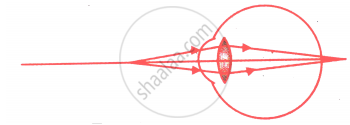
Observe the figure and answer the following questions:

- Name the defect of vision represented in the above figure.
- State the reasons for this defect.
- How is it corrected?
- Draw the diagram to show the correction of this defect.
Observe the following diagram and answer questions following it:

- Identify the defect of vision shown.
- List its two causes.
- Name the type of lens used for the correction of this defect.
