Advertisements
Advertisements
Question
Name one defect of vision (or eye) which cannot be corrected by any type of spectacle lenses.
Advertisements
Solution
Cataract is a defect of vision that cannot be corrected by any type of spectacle lenses
APPEARS IN
RELATED QUESTIONS
What is the other name for
myopia
What is the scientific name of
short-sightedness
What is the scientific name of
long-sightedness?
What is the other name of old age hypermetropia?
Explain with the help of labelled ray-diagram, the defect of vision called hypermetropia, and hot it is corrected by a lens.
To read a book held at a distance of 25 cm, will she need converging or diverging spectacle lenses?
Name the following:
The photosensitive pigment present in the rods of the retina.
Differentiate between members of the following pair with reference to what is asked in bracket.
Myopia and hyperopia (cause of the defect)
Have a look at the posture of this girl who is reading a book and answer the questions which follow:

Name the problem she is facing.
State one role of ciliary muscles in the human eye.
Anuja cannot see the blackboard writing but she can see nearby things.
(a) What is the eye defect she is suffering from?
(b) State the possible reason for her defect.
(c) How is it corrected
Differentiate between:
Short-sightedness and Long-sightedness.
Complete the following sentence with appropriate word :
An inability to focus on nearby objects due to loss of elasticity of the lens with age is called Iris.
Due to elongation of _______ and increase in curvature of the eye lens, a person cannot see distant objects clearly.
Observe the given below the figure, correct it and explain and write about the concept depicted in this figure.
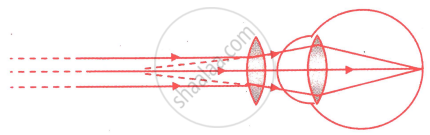
Differentiate the eye defects: Myopia and Hypermetropia
Which of the following statement is correct?
Observe the following diagram and answer questions following it:

- Identify the defect of vision shown.
- List its two causes.
- Name the type of lens used for the correction of this defect.
