Advertisements
Advertisements
Question
Which of the following statement is correct?
Options
A person with myopia can see distant objects clearly
A person with hypermetropia can see nearby objects clearly
A person with myopia can see nearby objects clearly
A person with hypermetropia cannot see distant objects clearly
Advertisements
Solution
A person with myopia can see nearby objects clearly
Explanation -
Nearsightedness or myopia is the inability of the eye to see the far located objects clearly.
APPEARS IN
RELATED QUESTIONS
List three common refractive defects of vision. Suggest the way of correcting these defects.
A student is unable to see clearly the words written on the black board placed at a distance of approximately 3 m from him. Name the defect of vision the boy is suffering from. State the possible causes of this defect and explain the method of correcting it.
Name the defect of vision in a person:
whose near point is more than 25 on away.
Name the defect of vision which makes the eye-lens cloudy resulting in blurred vision.
Your friend can read a book perfectly well but cannot read the writing on blackboard unless she sits on the front row in class.
What type of lenses-converging or diverging-would an optician prescribe for her?
A man can read the number of a distant bus clearly but he finds difficulty in reading a book.
- From which defect of the eye is he suffering?
- What type of spectacle lens should he use to correct the defect?
A man can read the number of a distant but clearly but he finds difficulty in reading a book.
What type of spectacle lens should he use to correct the defect?
What is long-sightedness? State the two causes of long-sightedness (or hypermetropia). With the help of ray diagrams, show:
(i) the eye-defect long-sightedness.
(ii) correction of long-sightedness by using a lens.
To read a book held at a distance of 25 cm, will she need converging or diverging spectacle lenses?
Given below is a diagram depicting a defect of the human eye. Study the same and answer the question that follow:

Name the defect shown in the diagram.
State the main functions of the following:
Tears
Choose the correct answer :
Presbyopia is a disease of _____________
Given below is a diagram depicting a defect of the human eye? Study the same and answer the question that follow :
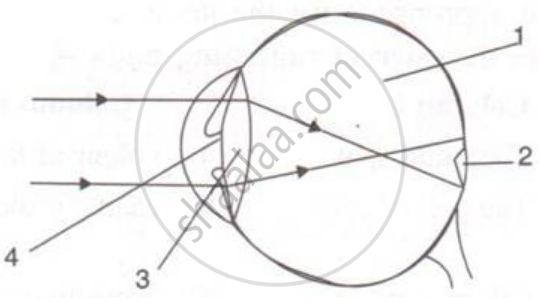
Name the type of lens used to correct this eye defect.
Rewrite the following table so as to match second and third column with first column.
|
Column I
|
Column II
|
Column III
|
|
(i) Myopia
|
Old age problem
|
Bifocal lens
|
|
(ii) Presbyopia
|
Nearsightedness
|
Concave lens.
|
Give Reason:
Why do we see clearly in the central region of the retina?
Give Reason:
Older people require glasses to read and write.
Give Technical Term:
The path which responsible for protecting the eye from sweat.
Assertion: Myopia is the defect of vision in which a person cannot see distant objects clearly.
Reason: This due to eye-ball being too short.
