Advertisements
Advertisements
Question
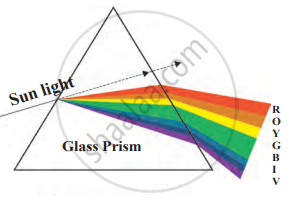
Draw a diagram to show how white light can be dispersed into a spectrum by using a glass prism. Mark the various colours of the spectrum.
Advertisements
Solution
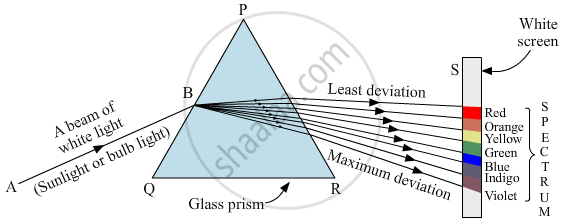
The diagram shows the dispersion of white light into a spectrum of colours by using a glass prism. The various colours of the spectrum are shown in the diagram.
RELATED QUESTIONS
In the figure given alongside, a narrow beam of white light is shown to pass through a triangular glass prism. After passing through the prism, it produces a spectrum YX on the screen.
Why do different colours of white light bend through different angles with respect to the incident beam of light?
The colour of white light which is deviated the maximum on passing through the glass prism is:
(a) blue
(b) indigo
(c) red
(d) orange
The coloured light having the maximum speed in glass prism is ______.
A ray of white light falls on a prism. Draw a ray diagram to show that the prism disperses the white light.
A ray of white light is passed through a glass prism and a spectrum is obtained on a screen.
- Name the seven colours of the spectrum in order.
- Do the colours have the same width in the spectrum?
- Which of the colour of the spectrum of white light deviates (i) the most, (ii) the least?
In an experiment to trace the path of a ray of light through a glass prism for different values of angle of incidence a student would find that the emergent ray:
(A) is parallel to the incident ray
(B) perpendicular to the incident ray
(C) is parallel to the refracted ray
(D) bends at an angle to the direction of incident ray
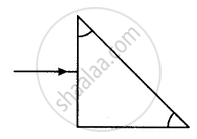
In the diagram, a narrow beam of white light is incident on a right-angled isosceles prism. The critical angle of the material of prism for the yellow colour of white light is 45°. Complete the diagram to show the path of blue, yellow, and red colours of white light till they emerge out of the prism.
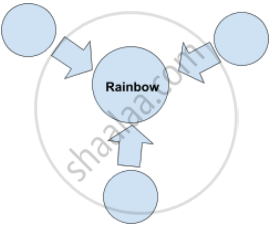
Rainbow is a beautiful natural phenomenon. It is the combined effect of a natural three processes together produced by light. Write it into the circle.
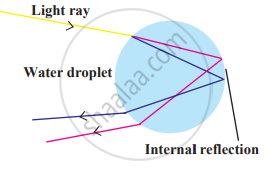
Observe the given figure and write appropriate phenomenon of light in the box.
A ray of light is incident at 45° on an equilateral prism in the diagram below.

- Name the phenomenon exhibited by the ray of light when it enters and emerges out of the prism.
- State the cause of the above phenomenon mentioned by you.
