Advertisements
Advertisements
Question
Answer the following:
What do you mean by dispersion? Name the different colours of light in the proper sequence in the spectrum of light.
Advertisements
Solution
- The phenomenon of splitting of light into its component colours is called dispersion of light.
- In the spectrum of light splitting of white light into different colours takes place. Various colours obtained in spectrum of light are in the sequence - Violet, Indigo, Blue, Green, Yellow, Orange and red.
APPEARS IN
RELATED QUESTIONS
Study the following diagrams in which the path of a ray of light passing through a glass prism as traced by four students P, Q, R and S is shown:

The student who has traced the path correctly is
(A) P
(B) Q
(C) R
(D) S
After tracing the path of a ray of light through a glass prism a student marked the angle of incidence (∠i), angle of refraction (∠r) angle of emergence (∠e) and the angle of deviation (∠D) as shown in the diagram. The correctly marked angles are :

(A) ∠i and ∠r
(B) ∠i and ∠e
(C) ∠i, ∠e and ∠D
(D) ∠i, ∠r and ∠e
The path of a ray of light passing through a glass prism is shown below:
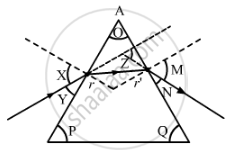
In this diagram, the angle of prism, angle of incidence, angle of emergence and angle of deviation, respectively, have been represented by:
(A) O, Y, Z and N,
(B) P, Y, M and Z,
(C) O, X, M and Z,
(D) P, X, Z and N.
State the cause of dispersion of white light
As light rays pass from air into a glass prism, are they refracted towards or away from the normal?
In the formation of spectrum of white light by a prism:
which colour is deviated most?
In the figure given alongside, a narrow beam of white light is shown to pass through a triangular glass prism. After passing through the prism, it produces a spectrum YX on the screen.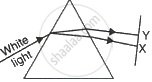
- State the colour seen
- at X, and
- at Y.
- Why do different colours of white light bend through different angles with respect to the incident beam of light?
Draw a diagram to show how white light can be dispersed into a spectrum by using a glass prism. Mark the various colours of the spectrum.
Name the process which is involved in the formation of a rainbow.
A beam of white light falls on a glass prism. The colour of light which undergoes the least bending on passing through the glass prism is:
(a) violet
(b) red
(c) green
(d) blue
Explain briefly, with the help of a neat labelled diagram, how white light gets dispersed by a prism. On which surface of a prism, there is both dispersion and deviation of light, and on which surface of the prism, there is only deviation of light ?
What do you understand by the term spectrum?
In an experiment to trace the path of a ray of light through a glass prism for different values of angle of incidence a student would find that the emergent ray:
(A) is parallel to the incident ray
(B) perpendicular to the incident ray
(C) is parallel to the refracted ray
(D) bends at an angle to the direction of incident ray
When we place a glass prism in the path of a narrow beam of white light a spectrum is obtained. What happens when a second identical prism is placed in an inverted position with respect to the first prism? Draw a labelled ray diagram to illustrate it.
The wavelengths of violet and red light are 4000 Å and 8000 Å respectively. Which of the two has the higher frequency?
The phenomenon of splitting of light into its component colours is ___________ .
Draw a labelled diagram: Dispersion of light through a prism.
Differentiate between a glass slab and a glass prism.
What do you understand by spectrum? Name the seven prominent colours in order, as obtained in the spectrum of white light.
When sunlight passes through water droplets in the atmosphere it gets dispersed into its constituent colours forming a rainbow. A similar phenomenon is observed when white light passes through a prism.
Instead of sunlight, a green-coloured ray is passed through a glass prism. What will be the colour of the emergent ray?
