Advertisements
Advertisements
Question
A block and tackle system of pulleys has a velocity ratio of 4.
- Draw a labelled diagram of the system indicating clearly the points of application and directions of load and effort.
- What is the value of the mechanical advantage of the given pulley system if it is an ideal pulley system?
Advertisements
Solution
(a)

(b) M. A. = `"Load"/"Efforts" = (4"T"_"L")/"T"_"E" = 4`
RELATED QUESTIONS
Is the above pulley system an ideal machine or not?
State two functions of a machine.
Define the following term in reference to a gear system of Driving gear ?
Name the type of single pulley that can act as a force multiplier. Draw a labelled diagram of the pulley mentioned by you.
Give two reasons why the efficiency of a single movable pulley system is not 100%.
The diagram below shows a pulley arrangement.
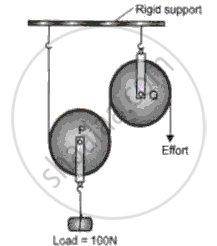
(i) In the diagram, mark the direction of the forces due to tension, acting on the pulley P.
(ii) What is the purpose of the pulley Q?
(iii) If the tension is T newton, deduce the relation between T and E.
(iv) Calculate the velocity ratio of the arrangement.
(v) Assuming that the efficiency of the system is 100%, what is the mechanical advantage?
(vi) Calculate the value of E
If the weight of the movable pulley is W, obtain the expression for MA, VR, and efficiency.
Name the type of single pulley that has an ideal mechanical advantage equal to 2. Draw a labelled diagram of the pulley mentioned by you.
