Advertisements
Advertisements
Question
Draw a diagram of a combination of three movable pulleys and one fixed pulley to lift up a load. In the diagram, show the directions of load, effort and tension in each strand. Find:
- mechanical advantage,
- Velocity ratio and
- efficiency of the combination in ideal situation.
Advertisements
Solution
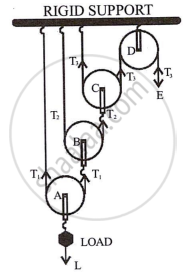
A, B, and C are a movable pulley and D is a fixed pulley.
- M.A.
In equilibrium, Effort E = T3 ...(i)
Since the two string segments that cross pulley A support the load L, tension T1 in this string is 2T1 = L.
or T1 = `L/2` ...(ii)
Similar to how the two sections of string that cross pulley B support tension T1, tension T2 in this string is
`2T_2 = T_1 or T_2 = T_1/2 = L/2^2` ...(iii)Likewise, the string tension T3 that crosses the pulley C is
`2T_3 = T_2 or T_3 = T_2/2 = L/2^3` ...(iv)
from (iv)
Load L = `2^3 xx T_3` ...(v)
E = `L/2^3` ...(vi)
Hence, mechanical advantage
M.A = `"Load L"/ "effort E"`
= `(2^2 xx T_3)/T_3 = 2^3` ...(vii)
Generally speaking, if there are n movable pulleys and 1 fixed pulley.
M.A = 2n here n = 3
∴M.A. = 23 ...(i) -
Velocity Ratio: When a string crosses a movable pulley, its other end travels up twice as far as the pulley's axle moves. This is because one end of the string is stationary. If the load L attached to the pulley A moves up by distance X i.e. dL = X, the string connected to the axle of pulley B moves up by a distance 2 × x = 2x, the string connected to the axle of pulley c moves up by a distance 2 × 2x = 22 x and the end of the string moving over the fixed pulley D moves up by a distance 2 × 22 x = 23 x, i.e. the effort E moves by a distance 23x or dE = 23 x
∴ Velocity Ratio V.R. = `("distance moved by effort" d_E)/("distance moved by load" d_L)`
= `(2^3x)/(x) = 2^3` ...(ii) - Efficiency = `("M.A.")/("V.R.")` ...from (i) and (ii)
η = `2^3/2^3 = 1 or 100%`
RELATED QUESTIONS
A pulley system with VR = 4 is used to lift a load of 175 kgf through a vertical height of 15 m. The effort required is 50 kgf in the downward direction. (g = 10 N kg-1)
Calculate:
- Distance moved by the effort
- Work done by the effort
- M.A. of the pulley system
- Efficiency of the pulley system
The mechanical advantage of an actual pulley is less than one. Give a reason. What is the justification for using the pulley then?
What is a gear system ?
Explain the working of a gear system.
What should be the gear ration of a car : equal to 1, less than 1 or greater than 1, while gaining speed on the road ?
Give two reasons why the efficiency of a single movable pulley system is not 100%.
What is the use of a fixed pulley?
Give reason for the following:
The efficiency of a pulley is always less than 100%
A block and tackle system of pulleys has a velocity ratio of 4.
- Draw a labelled diagram of the system indicating clearly the points of application and directions of load and effort.
- What is the value of the mechanical advantage of the given pulley system if it is an ideal pulley system?
| Meera chose to use a block and tackle system of '9' pulleys instead of a single movable pulley to lift a heavy load. |
Why should she connect more number of pulleys in the upper fixed block?
