Advertisements
Advertisements
प्रश्न
Draw a diagram of a combination of three movable pulleys and one fixed pulley to lift up a load. In the diagram, show the directions of load, effort and tension in each strand. Find:
- mechanical advantage,
- Velocity ratio and
- efficiency of the combination in ideal situation.
Advertisements
उत्तर
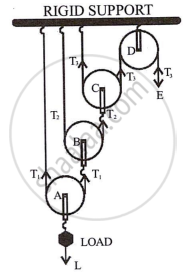
A, B, and C are a movable pulley and D is a fixed pulley.
- M.A.
In equilibrium, Effort E = T3 ...(i)
Since the two string segments that cross pulley A support the load L, tension T1 in this string is 2T1 = L.
or T1 = `L/2` ...(ii)
Similar to how the two sections of string that cross pulley B support tension T1, tension T2 in this string is
`2T_2 = T_1 or T_2 = T_1/2 = L/2^2` ...(iii)Likewise, the string tension T3 that crosses the pulley C is
`2T_3 = T_2 or T_3 = T_2/2 = L/2^3` ...(iv)
from (iv)
Load L = `2^3 xx T_3` ...(v)
E = `L/2^3` ...(vi)
Hence, mechanical advantage
M.A = `"Load L"/ "effort E"`
= `(2^2 xx T_3)/T_3 = 2^3` ...(vii)
Generally speaking, if there are n movable pulleys and 1 fixed pulley.
M.A = 2n here n = 3
∴M.A. = 23 ...(i) -
Velocity Ratio: When a string crosses a movable pulley, its other end travels up twice as far as the pulley's axle moves. This is because one end of the string is stationary. If the load L attached to the pulley A moves up by distance X i.e. dL = X, the string connected to the axle of pulley B moves up by a distance 2 × x = 2x, the string connected to the axle of pulley c moves up by a distance 2 × 2x = 22 x and the end of the string moving over the fixed pulley D moves up by a distance 2 × 22 x = 23 x, i.e. the effort E moves by a distance 23x or dE = 23 x
∴ Velocity Ratio V.R. = `("distance moved by effort" d_E)/("distance moved by load" d_L)`
= `(2^3x)/(x) = 2^3` ...(ii) - Efficiency = `("M.A.")/("V.R.")` ...from (i) and (ii)
η = `2^3/2^3 = 1 or 100%`
संबंधित प्रश्न
Is the above pulley system an ideal machine or not?
The diagram below shows an arrangement of three pulleys A, B, and C. The load is marked as L and the effort as E.
- Name the Pulleys A, B, and C.
- Mark in the diagram the directions of load (L), effort (E) and tension T1 and T2 in the two strings.
- How are the magnitudes of L and E related to the tension T1?
- Calculate the mechanical advantage and velocity ratio of the arrangement.
- What assumptions have you made in parts (c) and (d)?

Give reason for the following:
The lower block of a block and tackle pulley system must be of negligible weight
What is a block and tackle system of pulleys? What precautions would you observe while rounding the string so that the effort is applied in the downward direction?
The pulley system shown in the figure is to be used to lift a load W. If the man applying the effort cannot apply a force exceeding 1000 N, what is the maximum load that can be lifted?
The actual load that the man is finally able to lift turns out to be 2700 N. What are the values of the actual M.A., obtained, and the efficiency of the actual set-up?
A block and tackle system of pulleys has a velocity ratio of 4.
- Draw a labelled diagram of the system indicating clearly the points of application and directions of load and effort.
- What is the value of the mechanical advantage of the given pulley system if it is an ideal pulley system?
A boy lifts a load of 40 kgf through a vertical height of 2m in 5s by using a single fixed pulley when he applies an effort of 48 kgf. Calculate:
(i) the mechanical advantage, and
(ii) the efficiency of the pulley. Why is the efficiency of the pulley is not 100%?
(iii) the energy gained by the load in 5s, and
(iv) the power developed by the boy in raising the load.
State one advantage of single movable pulley.
A block and tackle system of pulleys has a velocity ratio of 4.
- Draw a labelled diagram of the system indicating clearly the direction of the load and effort.
- Calculate the potential energy of the load 100 kgf lifted by this pulley to a height 5 m. (g = 10 ms−2)
Name the type of single pulley that has an ideal mechanical advantage equal to 2. Draw a labelled diagram of the pulley mentioned by you.
