Advertisements
Advertisements
प्रश्न
Draw a diagram showing a block and tackle system of 4 pulleys.

(i) State, how many strands of tackle support the load?
(ii) Draw arrows to represent tension in each strand.
(iii) Find the mechanical advantage of the system, stating the assumptions made.
(iv) If the load is pulled up by a distance 1m, how much does the effort end move?
Advertisements
उत्तर
The adjacent diagram shows a block and tackle system of 4 pulleys.
(i) Four strands of tackle support the load.
(ii) The tension in each strand is shown by the arrow marked as T.
(iii) If we neglect the friction of the pulleys and weight of the pulleys in the lower block, then:
L = 4T
and E = T
∴ M.A. =`"L"/"E"`
= `(4"T")/"T"`
= 4.
(iv) If the load is pulled up by a distance 1m, the effort end moves by 4 m.
संबंधित प्रश्न
Define the following term in reference to a gear system for Driven gear ?
Define the following term in reference to a gear system for Gain in torque ?
In a gear system, the gear ration of the driving wheel A and driven wheel B is 10:1. To rotate the driven wheel B in the direction of driving wheel A, the driving wheel A is engaged with other wheel C. what should be the gear ratio of the wheels A and C?
Give two reasons why the efficiency of a single movable pulley system is not 100%.
A pulley system has a velocity ratio 3. Draw a diagram showing the point of application and direction of load (L), effort (E) and tension (T). It lifts a load of 150 N by an effort of 60 N. Calculate its mechanical advantage. Is the pulley system ideal? Give reason.
The diagram below shows a pulley arrangement.
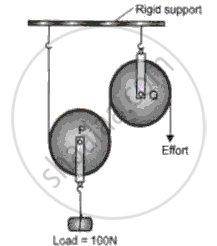
(i) In the diagram, mark the direction of the forces due to tension, acting on the pulley P.
(ii) What is the purpose of the pulley Q?
(iii) If the tension is T newton, deduce the relation between T and E.
(iv) Calculate the velocity ratio of the arrangement.
(v) Assuming that the efficiency of the system is 100%, what is the mechanical advantage?
(vi) Calculate the value of E
In the case of a block and tackle arrangement, the mechanical advantage increases with the number of pulleys. Explain.
A type of single pulley is very often used as a machine even though it does not give any gain in mechanical advantage. Name the type of pulley used.
What is a pulley?
Complete the table.
| S. No | Types of Simple Machine | Example |
| 1. | Pulley | |
| 2. | Wheel and axle | |
| 3. | Wedge | |
| 4. | Inclined plan | |
| 5. | Lever | |
| 6. | Screw |
