Advertisements
Advertisements
Question
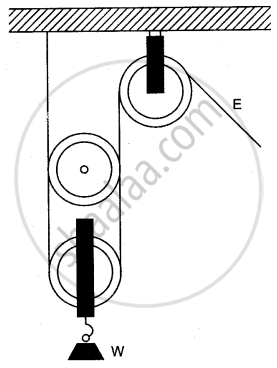
In the alongside the figure of two pulleys shown a system in which one pulley is fixed and the other is movable. What is the velocity ratio of the system?
An effort of 600 N is needed to lift a weight of 1000 N. What are the mechanical advantage and efficiency of the pulley system?
Advertisements
Solution
If there are n movable pulleys connected to a fixed pulley, then the velocity ratio is
V.R = 2n
Velocity ratio of the system = 2.
Mechanical Advantage = `"Load"/"Effort"=1000/600`
=`5/3`
Efficiency = `"M.A."/"V.R."`
= `(5//3)/2=5/(3xx2)=5/6`
= 83.3%.
RELATED QUESTIONS
Solve the following numerical problem.
What effort will be required to lift a load of 500 N by a single movable pulley? [Hint: Mechanical advantage of a single movable pulley is two].
Explain the working of a gear system.
What is a block and tackle system of pulleys?
The diagram below shows a pulley arrangement :
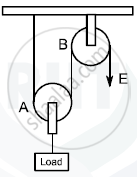
(i) Copy the diagram and mark the direction of tension on each strand of the string.
(ii) What is the velocity ratio of the arrangement ?
(iii) If the tension acting on the string is T, then what is the relationship between T and effort E ?
(iv) If the free end of the string moves through distance x, find the distance by which the load is raised.
Give a reason for the following:
In a single fixed pulley, the velocity ratio is always more than the mechanical advantage.
Draw a diagram of a single fixed pulley and obtain expressions for its:
(i) Mechanical advantage,
(ii) Velocity ratio, and
(iii) Efficiency, in the ideal case.
A block and tackle system of pulleys has a velocity ratio of 4.
- Draw a labelled diagram of the system indicating clearly the points of application and directions of load and effort.
- What is the value of the mechanical advantage of the given pulley system if it is an ideal pulley system?
In a single movable pulley system, a load of 125 kgf is lifted by an effort of 75 kgf. Find the percentage efficiency of system.
A boy lifts a load of 40 kgf through a vertical height of 2m in 5s by using a single fixed pulley when he applies an effort of 48 kgf. Calculate:
(i) the mechanical advantage, and
(ii) the efficiency of the pulley. Why is the efficiency of the pulley is not 100%?
(iii) the energy gained by the load in 5s, and
(iv) the power developed by the boy in raising the load.
| Meera chose to use a block and tackle system of '9' pulleys instead of a single movable pulley to lift a heavy load. |
Why should she connect more number of pulleys in the upper fixed block?
