Advertisements
Advertisements
प्रश्न
Answer the following question:
Distinguish between the convex mirror and the concave mirror.
Advertisements
उत्तर
Convex mirror and concave mirror.
| Convex mirror | Concave mirror | |
| 1. | It is called a diverging mirror. | It is called a converging mirror. |
| 2. | The light is reflected from the outer surface. | The light is reflected from the inner surface. |
| 3. | It can form only a virtual image | It can form a real image as well as a virtual image. |
| 4. | According to sign convention, the focal length is positive. | According to sign convention, the focal length is negative. |
APPEARS IN
संबंधित प्रश्न
A simple microscope is used by watch repairers. Give reason.
Define the following term in the context of spherical mirrors:- Pole
Image formed by a convex ______ is always virtual and smaller in size.
A concave mirror always forms a real image.
A ray of light strikes a plane mirror at an angle of 40° to the mirror surface. What will be the angle of reflection?
Name the spherical mirror which has:
(a) virtual principal focus.
(b) real principal focus.
What is the relation between the focal length and radius of curvature of a spherical mirror (concave mirror or convex mirror)?
Name the spherical mirror which can produce a real and diminished image of an object.
Name the spherical mirror which can produce a virtual and diminished image of an object.
The shiny outer surface of a hollow sphere of aluminium of radius 50 cm is to be used as a mirror:
Which type of spherical mirror will it provide?
A ray of light travels from a denser medium to a rarer medium. How will it bend?
Which are the two convenient rays that are chosen to construct the image by a spherical mirror for a given object? Explain with the help of suitable ray diagrams.
An optical device has been given to a student and he determines its focal length by focusing the image of the sun on a screen placed 24 cm from the device on the same side as the sun. Select the correct statement about the device.
(A) Convex mirror of focal length 12 cm
(B) Convex lens of focal length 24 cm
(C) Concave mirror of focal length 24 cm
(D) Convex lens of focal length 12 cm
Three mirrors are created from a single sphere. Which of the following - pole, centre of curvature, radius of curvature, principal axis - will be common to them and which will not be common?
Define the terms focus and focal length of a concave mirror. Draw diagram to illustrate your answer.
State whether the image in part (a) is real or virtual?
Write two more characteristics of the image.
Select the correct option:
A mirror forms a virtual image (diminished) of an object, whatever be the position of object:
Select the correct option:
Looking into a mirror one finds her image diminished, the mirror is:
Select the correct option:
Which mirror is used in periscope?
Define the following term:
spherical mirror
Define the following term:
convex mirror
Define the following term in relation to concave mirror.
Center of curvature
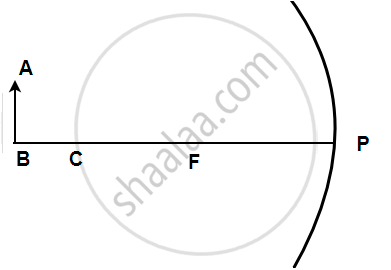
The following figure shows a concave mirror with its pole (P), focus (F), and center of curvature (C). Draw a ray diagram to show the formation of the image of an object AB by the concave mirror.
Complete the following diagrams shown in the below figure by drawing the reflected ray for each incident ray.
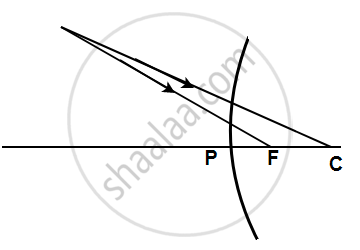
Define the term Principle focus.
Draw a ray diagram to show that a convex mirror has a wider field of view.
An object 10 cm high is placed at a distance of 20 cm in front of a spherical mirror of focal length 25 cm. By scale drawing find the nature, position, and magnification of the image in the following case:
Convex mirror
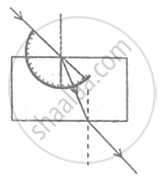
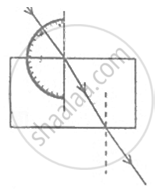
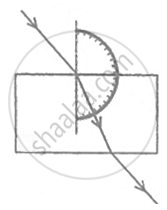
A student traces the path of a ray of light passing through a rectangular slab.
 |
 |
 |
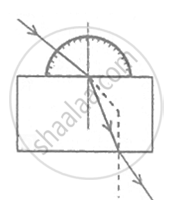 |
For measuring the angle of incidence, he must position the protractor in the manner shown in the figure:
If the real image of a candle flame formed by a lens is three times the size of the flame and the distance between lens and image is 80 cm, at what distance should the candle be placed from the lens?
Name the two types of spherical mirrors.
Define the radius of curvature.
What is “aperture”?
