Advertisements
Advertisements
Question
Answer the following question:
Distinguish between the convex mirror and the concave mirror.
Advertisements
Solution
Convex mirror and concave mirror.
| Convex mirror | Concave mirror | |
| 1. | It is called a diverging mirror. | It is called a converging mirror. |
| 2. | The light is reflected from the outer surface. | The light is reflected from the inner surface. |
| 3. | It can form only a virtual image | It can form a real image as well as a virtual image. |
| 4. | According to sign convention, the focal length is positive. | According to sign convention, the focal length is negative. |
APPEARS IN
RELATED QUESTIONS
Define the following term in the context of spherical mirrors:- Pole
Explain the following term related to spherical lenses:- principal focus
An image that cannot be obtained on a screen is called ______.
We can obtain an enlarged and erect image by a convex mirror.
A virtual image larger than the object can be produced by a ______.
What is the name of the phenomenon in which the right side of an object appears to be the left side of the image in a plane mirror?
Name the spherical mirror which has:
(a) virtual principal focus.
(b) real principal focus.
Name the two types of spherical mirrors. What type of mirror is represented by the:
front side of a shining steel spoon?
Name the spherical mirror which can produce a virtual and diminished image of an object.
The shiny outer surface of a hollow sphere of aluminium of radius 50 cm is to be used as a mirror:
Which type of spherical mirror will it provide?
Write the formula for a lens connecting image distance (v), object distance (u) and the focal length (f). How does the lens formula differ from the mirror formula?
A coin placed at the bottom of a vessel appears to be raised when water is poured in the vessel.
Name the kind of mirror used to obtain
(a) a real and enlarged image
(b) a virtual and enlarged image
(c) a real and diminished image, and
(d) a virtual and diminished image.
The letters on the front of an ambulance are written laterally inverted like  . Give reason.
What is a spherical mirror?
Name the two kinds of spherical mirrors and distinguish between them.
Draw suitable diagrams to illustrate the action of (i) concave mirror and (ii) convex mirror on a beam of light incident parallel to the principal axis.
Explain the meaning of the terms focus and focal length in case of a convex mirror, with the help of suitable ray diagram.
Figure shows a concave mirror with its pole at P, focus F and centre of curvature C. Draw ray diagram to show the formation of image of an object OA.
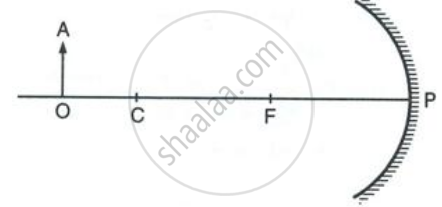
Draw a ray diagram to show the formation of image by a concave mirror for an object placed between its pole and focus. State three characteristics of the image.
Name the mirror which always produces an erect and virtual image. How is the size of image related to the size of object?
State the position of object for which the image formed by a concave mirror is of same size.
Write two more characteristics of the image.
How is the focal length of a spherical mirror related to its radius of curvature?
Which mirror will you prefer to use as a rear view mirror in a car : plane mirror or convex mirror? Give one reason.
Upto what maximum distance from the pole the image in a convex mirror can be obtained? what will be the location of object then ?
The sun is seen before the sunrise and after the sunset.
Define the following term in relation to concave mirror.
Principal focus
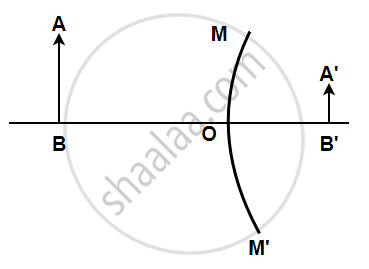
AB is the object, A1B1 is its image. MM' is the position of the mirror. Complete the ray diagram and find the position of the center of curvature and focus of the mirror. Also, measure the focal length.
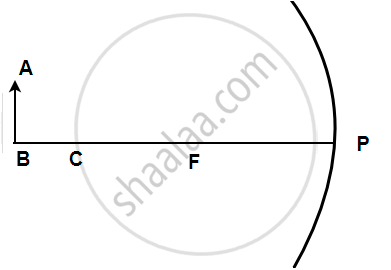
The following figure shows a concave mirror with its pole (P), focus (F), and center of curvature (C). Draw a ray diagram to show the formation of the image of an object AB by the concave mirror.
Define the term Pole.
Define the term Focus of a concave mirror.
The spherical mirror with a reflecting surface curved inward is called
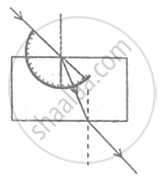
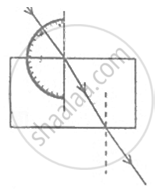
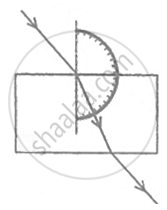
A student traces the path of a ray of light passing through a rectangular slab.
 |
 |
 |
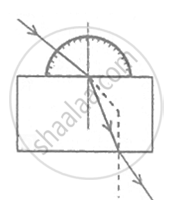 |
For measuring the angle of incidence, he must position the protractor in the manner shown in the figure:
Name the type of mirror used in the following situation:
Solar furnace
Support your answer with reason.
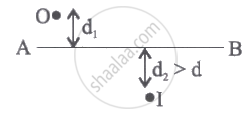
In the figure shown, the image of a real object is formed at the point I. AB is the principal axis of the mirror. The mirror must be:
In normal adjustment, for a refracting telescope, the distance between objective and eye piece is 30 cm. The focal length of the objective, when the angular magnification of the telescope is 2, will be ______.
