Advertisements
Advertisements
Question
Write the mirror formula. Give the meaning of each symbol which occurs in it.
Advertisements
Solution
The formula for a mirror is:
`1/v+1/u=1/f`
where, v = distance of image from mirror
u = distance of object from mirror
f = focal length of the mirror
APPEARS IN
RELATED QUESTIONS
A concave mirror always forms a real image.
Give one use each of a concave and a convex mirror.
What kind of mirror is required for obtaining a virtual image of the same size as the object?
A 2.0 cm tall object is placed 40 cm from a diverging lens of focal length 15 cm. Find the position and size of the image.
The letters on the front of an ambulance are written laterally inverted like  . Give reason.
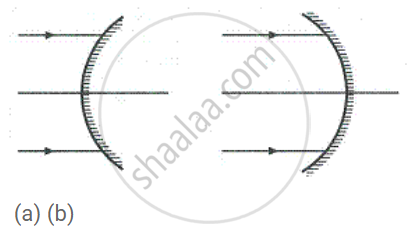
In each case (a) and (b), draw reflected rays for the given incident rays and mark focus by the symbol F.
Name the mirror which always produces an erect and virtual image. How is the size of image related to the size of object?
What is meant by magnification? Write its expression. What is its sign for the (a) real (b) virtual, image?
Define the following term:
spherical mirror
Define the following term in relation to concave mirror.
Pole
Define linear magnification produced by a mirror?
Numerical problem.
The radius of curvature of a spherical mirror is 25 cm. Find its focal length.
An object is placed at a distance of 0.25 m
in front of a plane mirror. The distance between the object and image will be ______.
Spherical mirrors are one form of ______ mirrors.
A spherical mirror whose reflecting surface is curved outwards is called ______ mirror.
The distance from the center of curvature of the mirror to the pole is called the focal length of the mirror.
Define the following terms in the context of a diverging mirror:
- Principal focus
- Focal length
Draw a labelled ray diagram to illustrate your answer.
