Advertisements
Advertisements
Question
A 4 cm tall object is placed on the principal axis of a convex lens. The distance of the object from the optical centre of the lens is 12 cm and its sharp image is formed at a distance of 24 cm from it on a screen on the other side of the lens. If the object is now moved a little away from the lens, in which way (towards the lens or away from the lens) will he have to move the screen to get a sharp image of the object on it again? How will the magnification of the image be affected?
Advertisements
Solution
Given that
Object distance, u = −12 cm
Image distance, v = 24 cm
`1/"f"=1/"v"-1/"u"`
`1/"f"=1/24-1/((-12))`
`1/"f"=1/8`
`therefore"f"=8cm`
The focal length of the lens is 8 cm.
Now if the object is moved away from the lens, the screen has to be moved towards the lens. This is because when we move the object away from the lens, the object distance is increased. Hence, by the lens formula, the image distance decreases.
Magnification is given as
`"m"="v"/"u"`
Because the image distance (v) decreases, the value of magnification also decreases.
APPEARS IN
RELATED QUESTIONS
Explain the following term related to spherical lenses:- aperture
A ray of light is incident normally on a plane mirror. What will be the
angle of reflection?
The letter F is placed in front of a plane mirror:
What is the name of the phenomenon involved?
Mention the types of mirrors used as (i) rear view mirrors, (ii) shaving mirrors. List two reasons to justify your answers in each case.
AB is the object, A1B1 is its image. MM' is the position of the mirror. Complete the ray diagram and find the position of the center of curvature and focus of the mirror. Also, measure the focal length.
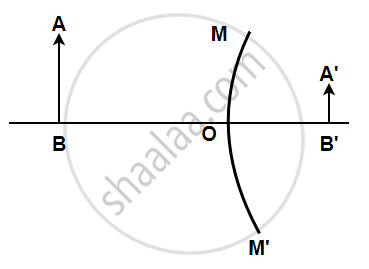
AB is the object, A'B' is the image, and MM' is the position of the mirror. Complete the ray diagram showing the formation of the image and find the focal length of the mirror.
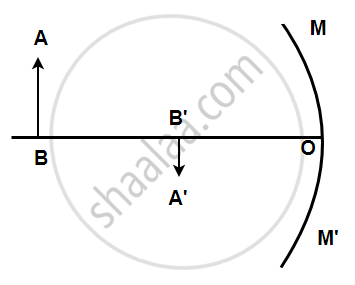
Which of the following has curved reflecting surface?
Define focal length.
A converging lens of focal length f is placed at a distance 0.3 m from an object to produce an image on a screen 0.9 m from the lens. With the object and the screen in the same positions, an image of the object could also be produced on the screen by placing a converging lens of focal length.
