Advertisements
Advertisements
Question
An object 5 cm high forms a virtual image of 1.25 cm high, when placed in front of a convex mirror at a distance of 24 cm. Calculate:
- the position of the image
- the focal length of the convex mirror.
Advertisements
Solution
Size of the object = h0 = 5 cm
Size of the image = h1 = +1.25 cm
Distance of the object from mirror = u = – 24 cm
Distance of the image from the mirror = v = ?
Focal length of the concave mirror = f = ?
(i) Magnification = m = `"h"_1/"h"_0 = - "v"/"u"`
`1.25/5 = (-"v")/-24`
v = `(24 xx 0.25)/5`
v = 24 × 0.25
v = 6 cm
(ii) Using mirror formula:
`1/"u" + 1/"v" = 1/"f"`
We have,
`1/-24 + 1/6 = 1/"f"`
`1/"f" = - 1/24 + 1/6 = (- 1 + 4)/24 = 3/24 = 1/8`
⇒ f = 8 cm
APPEARS IN
RELATED QUESTIONS
Define the following term in the context of spherical mirrors:- Centre of curvature
Give one use each of a concave and a convex mirror.
A diverging lens is used in ______.
State the number of images of an object placed between two mirrors, formed in each case when mirrors are inclined to each other at (a) 90°, and (b) 60°.
Draw a ray diagram to show the formation of image by a concave mirror for an object placed between its pole and focus. State three characteristics of the image.
How will you distinguish between a plane mirror, a concave mirror and a convex mirror, without touching them?
Define the following term in relation to concave mirror.
Center of curvature
An object 10 cm high is placed at a distance of 20 cm in front of a spherical mirror of focal length 25 cm. By scale drawing find the nature, position, and magnification of the image in the following case:
Convex mirror
Complete the following diagrams shown in the below figure by drawing the reflected ray for each incident ray.
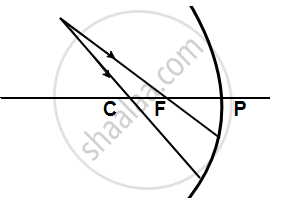
For a spherical mirror, ______ is true.
