Advertisements
Advertisements
Question
An object 10 cm high is placed at a distance of 20 cm in front of a spherical mirror of focal length 25 cm. By scale drawing find the nature, position, and magnification of the image in the following case:
Convex mirror
Advertisements
Solution
Focal length =25 cm.
Object distance = 20 cm.
Height o f object = 10 cm.
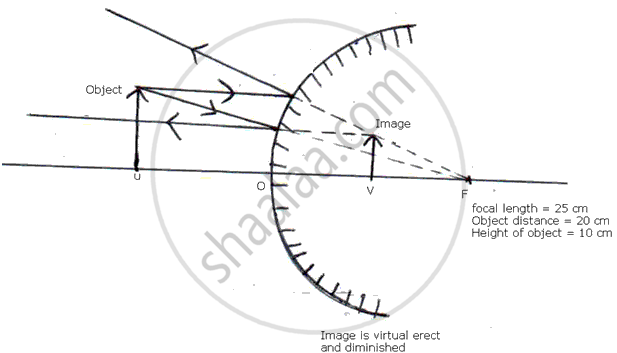 The image is virtual, erect, and diminished.
APPEARS IN
RELATED QUESTIONS
Explain the following term related to spherical lenses:- aperture
What happens when a ray of light falls normally (or perpendiculary) on the surface of a plane mirror?
The diverging lens in part (a) is replaced by a converging lens also of focal length 100 mm. The object remains in the same position and an image is formed by the converging lens. Compare two properties of this image with those of the image formed by the diverging lens in part (a).
Explain the following terms :
Pole, Centre of curvature, Radius of curvature, Principal axis. Show them on separate diagrams for each of the concave and convex mirrors.
What do you understand by the focus and focal length of a spherical mirror? Show them on the separate diagrams for each of a concave mirror and a convex mirror.
Three mirrors are created from a single sphere. Which of the following - pole, centre of curvature, radius of curvature, principal axis - will be common to them and which will not be common?
State the two convenient rays that are chosen to construct the image by a spherical mirror for a given object? Explain your answer with the help of suitable ray diagrams.
Name the mirror which always produces an erect and virtual image. How is the size of image related to the size of object?
